

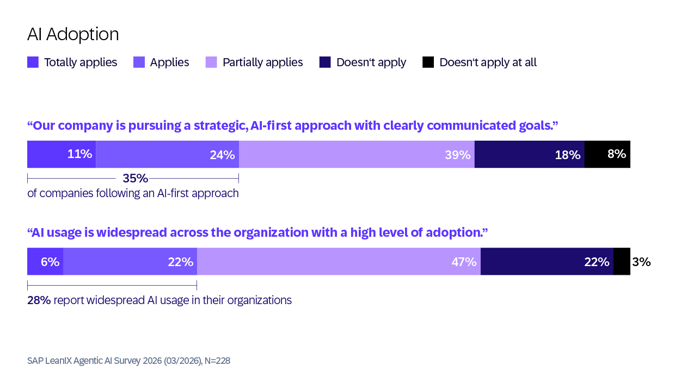
Artificial intelligence has become a part of everyday business operations in companies around the world: 75 percent of the companies surveyed for the "SAP LeanIX Agentic AI Survey 2026" are using AI, with more than a third pursuing a clear, strategic, "AI-first" approach. While 44 percent of firms already utilize AI agents, nearly all those surveyed are at least planning to develop and implement agents. The crucial question, therefore, is no longer whether companies will use AI agents, but how they will manage and account for this powerful innovation.
However, significant gaps are evident precisely in this area. There is a lack of transparency regarding agents in use, particularly when it comes to tracking agent performance, compliance, and return on investment (ROI), both actual and potential.
Although three-quarters of respondents believe that specific guidelines for AI agents are necessary, 48 percent of companies have not clearly defined responsibilities for their management and governance; instead, multiple teams are involved in these efforts.
Enterprise architects (EA) are not at the forefront in this regard: despite possessing the expertise needed to manage AI agents, EAs are currently sidelined in two-thirds of companies—even though 63 percent of respondents view EAs as positioned to strategically drive the adoption and use of artificial intelligence within their organizations.
The present study examines the reasons behind this situation, revealing the untapped potential for enterprise architects to move beyond merely supporting the deployment of agentic AI in their organizations and instead assume a key role in shaping it.
Survey of enterprise architects at companies around the world
As a market-leading provider in the enterprise architecture sector, SAP LeanIX boasts an extensive customer portfolio of companies and organizations around the world. For the "SAP Agentic AI Survey 2026," enterprise architecture leaders from 228 of these companies were surveyed online in March 2026. Seventy percent work for European companies, while another 18 percent are employed by firms in the USA or Canada. Regardless of region, the respondents are evenly distributed across companies of varying sizes, with 37 percent working in organizations with more than 10,000 employees.
AI usage is already part of everyday business
The significance of AI in a business context is evident from the findings: more than a third of respondents state that their companies are pursuing a strategic, "AI-first" approach with clearly defined goals. Overall, 75 percent report using AI within their organizations, with 28 percent describing this usage as extensive. Notably, the larger the company, the more likely it is to have a dedicated AI policy—and the more widespread AI adoption tends to be.
Forty-four percent of the companies surveyed are already deploying AI agents, though the vast majority are currently doing so only within limited functional areas. Almost as many—40 percent—are currently experimenting with AI agents, while another 14 percent plan to do so. It follows that questions regarding AI agents are a relevant for virtually all companies.
More than 60 percent of respondents state that agents are being deployed—or are planned for deployment—across multiple functions or departments.
Get the full picture
Submit the form to access the full study report
SAP LeanIX Agentic AI Survey 2026: More information about the study
In March 2026, SAP LeanIX conducted an online survey of 228 enterprise architects and IT decision-makers from internationally active customer organizations regarding the adoption and management of artificial intelligence—and AI agents in particular. The sample is balanced in terms of company size. 70 percent of the respondents are from companies in Europe, while another 18 percent are from the USA and Canada.
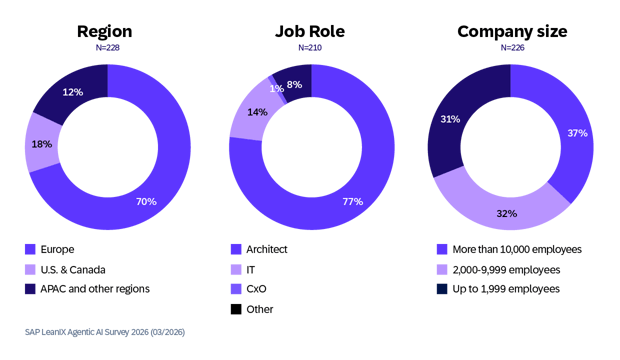
Differences in the number of respondents represented in the charts result from the exclusion of respondents who could not/would not provide information on individual topics.
For better readability, the results in this report are presented as percentage values without decimal places.