
A 2025 IT cost optimization survey conducted by SAP LeanIX solutions highlights avoidable expenses in IT budgets while revealing obstacles to effective cost reduction.
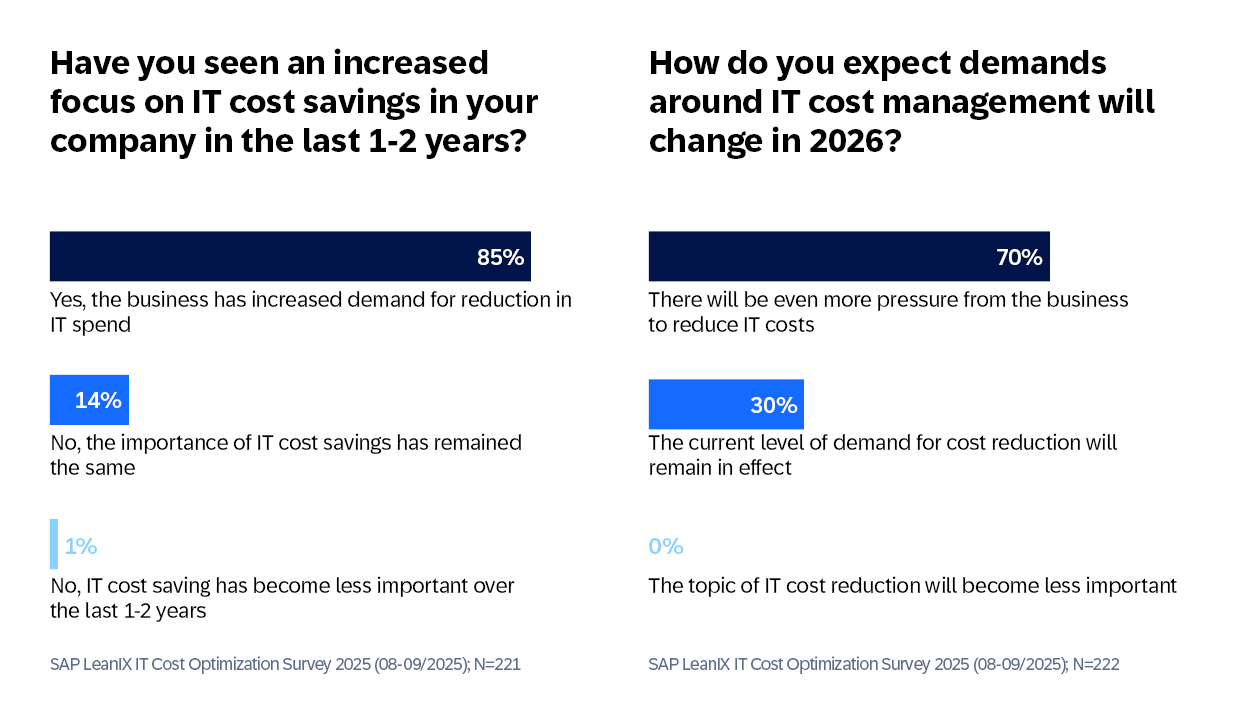
Bonn/Boston, December 9, 2025. The pressure to reduce IT costs has increased in 85% of companies surveyed over the past two years, and this pressure is expected to continue rising. This increased focus on IT costs is one of the key findings of SAP LeanIX’s Cost Optimization Survey 2025, for which 225 enterprise architecture (EA) managers from the global customer portfolio of market-leading EA provider SAP LeanIX were surveyed online.
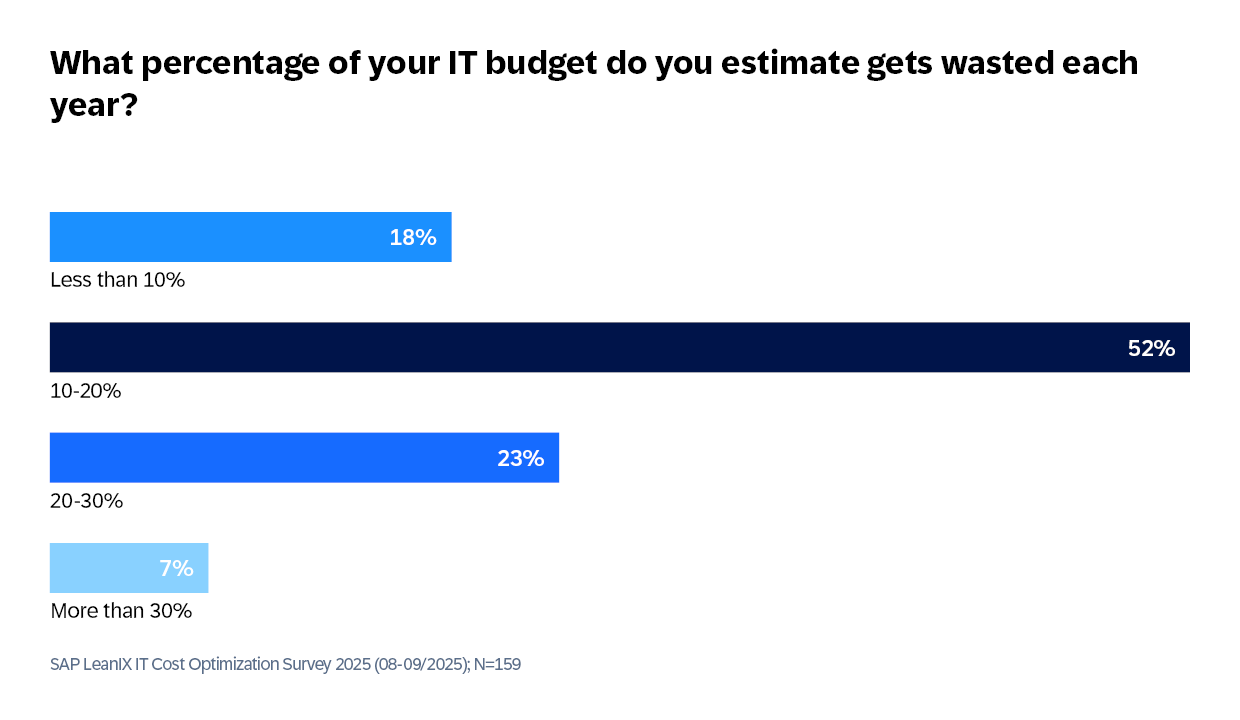
The study not only shows that companies actively aim for IT cost reduction but also reveals where they might start. In 82% of companies, wasted spend accounts for at least 10% to 20% of the annual IT budget, with redundant applications and technical debt the main culprits.
Given the common sources of wasted spend, it’s not surprising that most surveyed companies also report ongoing or planned application rationalization programs. However, respondents pointed to significant organizational and operational hurdles. First, collaboration between IT and business departments often proves difficult. The vast majority describe the decision-making process regarding the application portfolio as time-consuming and challenging.
Second, there is a widespread lack of data and transparency regarding the portfolio at the operational level. While access to relevant information for decision-makers varies, even in the best-case scenario, this data is often incomplete and not widely available.
Particularly problematic with regard to optimizing IT costs is the fact that information on the total cost of ownership (TCO) of applications is the most difficult to obtain. At the same time, 90% of respondents believe this TCO data can help accelerate decisions regarding the application portfolio. More generally, respondents believe a shared understanding of applications from a business perspective—an understanding that reliable TCO data supports—not only helps everyone achieve their goals but also improves long-term collaboration between IT and the business.
IT leaders currently face two major challenges. The initial enthusiasm over generative AI has transformed into a clear expectation for measurable results from AI use cases. At the same time, there is also the expectation that investment in this area will be funded from existing IT budgets. This desire to finance innovation by reallocating budget is a major factor behind the growing cost pressure felt by companies participating in this study.
The demand to reduce IT costs is growing
Eighty-five percent of respondents report an increased demand to reduce IT spending in the last two years. And 70% expect this pressure to increase in 2026.
To reduce costs, IT leaders would be best served by focusing on avoidable IT spend: 82% of respondents say that at least 10% to 20% of their company's IT budget is wasted each year. Indeed, 30% of respondents put this figure at higher than 20%.
Sixty percent of respondents cite redundant applications and technical debt as the reasons for these avoidable expenses. In nearly half of companies surveyed, overpaying for software-as-a-service (SaaS) licenses also contributes significantly to wasted IT spend.
Obstacles to application rationalization
The need to analyze and optimize the application portfolio is almost universally agreed upon. More than half of companies surveyed have implemented or are currently implementing measures to rationalize the application landscape, and another 40% plan to do so.
However, there are obstacles along the way. Sixty-one percent cite a lack of collaboration between IT and business stakeholders as the biggest challenge they face. And the vast majority (82%) describe the decision-making process regarding the application portfolio as time-consuming and difficult.
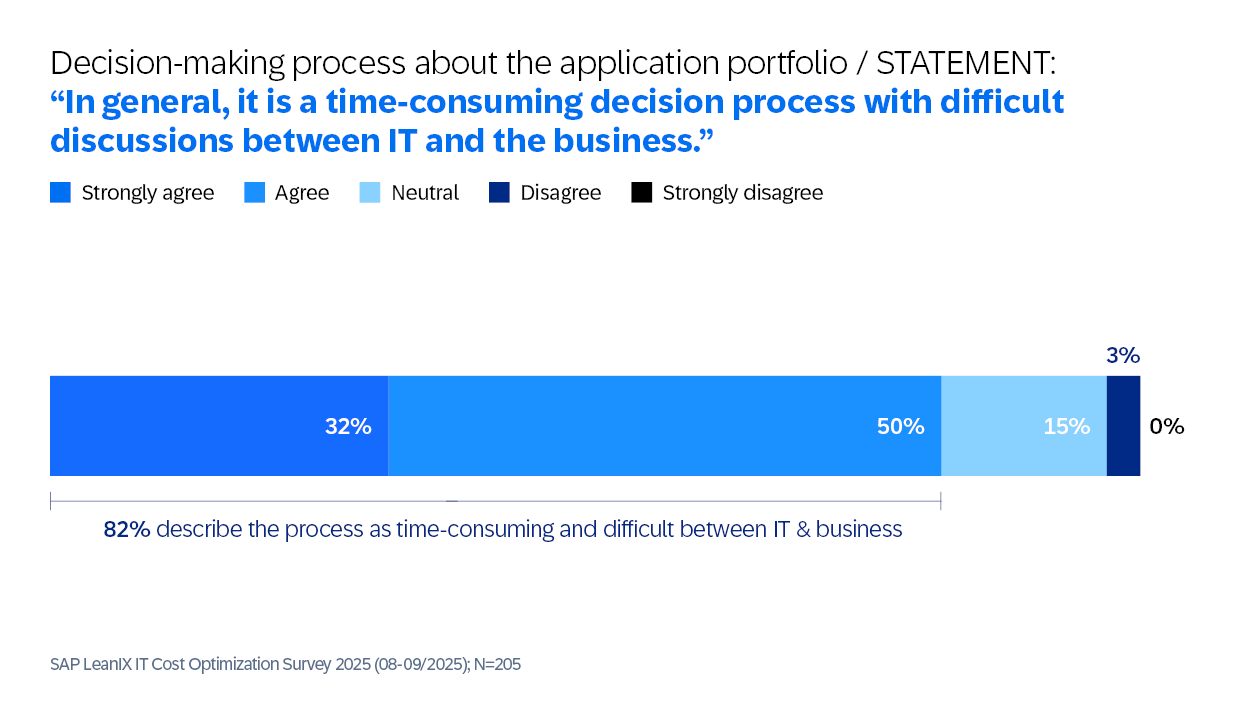
There are two fundamental types of difficulty these decision-makers face. First, there are organizational difficulties related to collaboration, roles, and deadlines. Second, there are difficulties associated with data and transparency. On this second point, the survey found that critical information regarding applications is often, at best, only partially available.
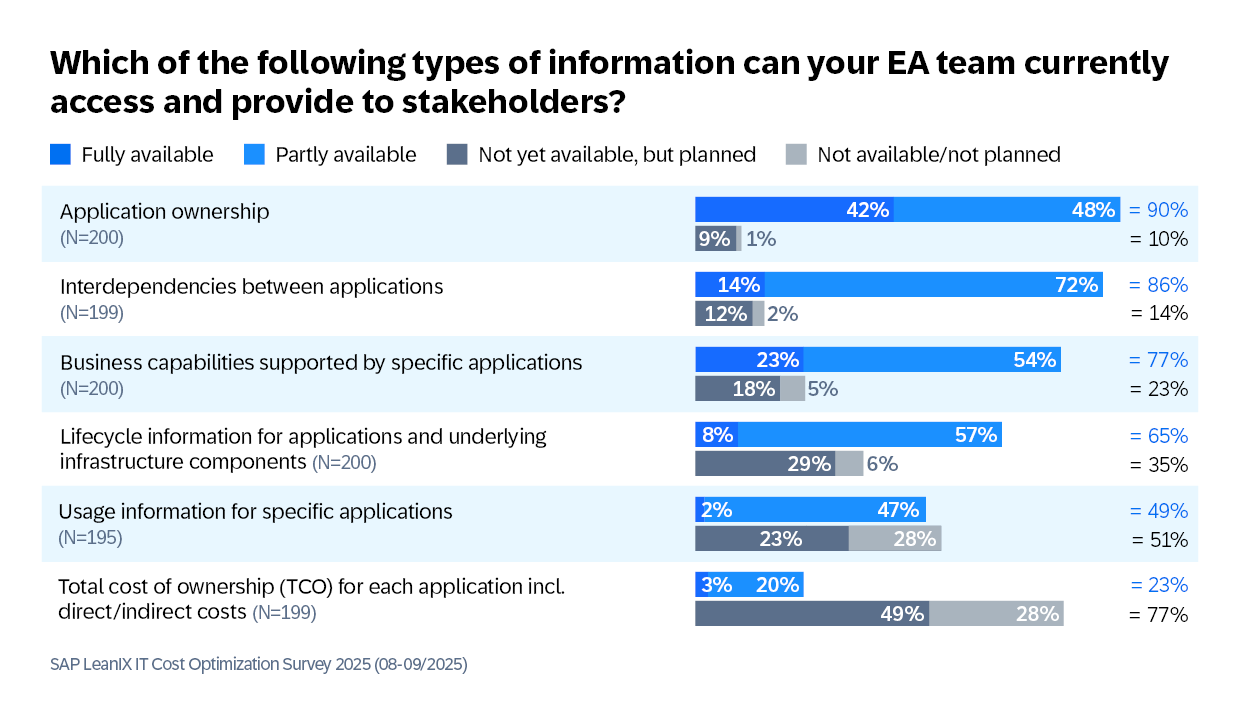
What’s more, in some cases the relevant information is not available at all. Information on TCO is particularly scarce. In 77% of cases, decision-makers cannot access this data today, although many plan to make it available.
Detailed cost data would accelerate decisions
Why are so many organizations planning on making TCO data available? Well, 90% of respondents believe this data would accelerate the application rationalization process. The biggest challenge in this regard is that cost data is distributed across various systems and not recorded in a central data source, making it difficult to aggregate and frequently inaccurate.
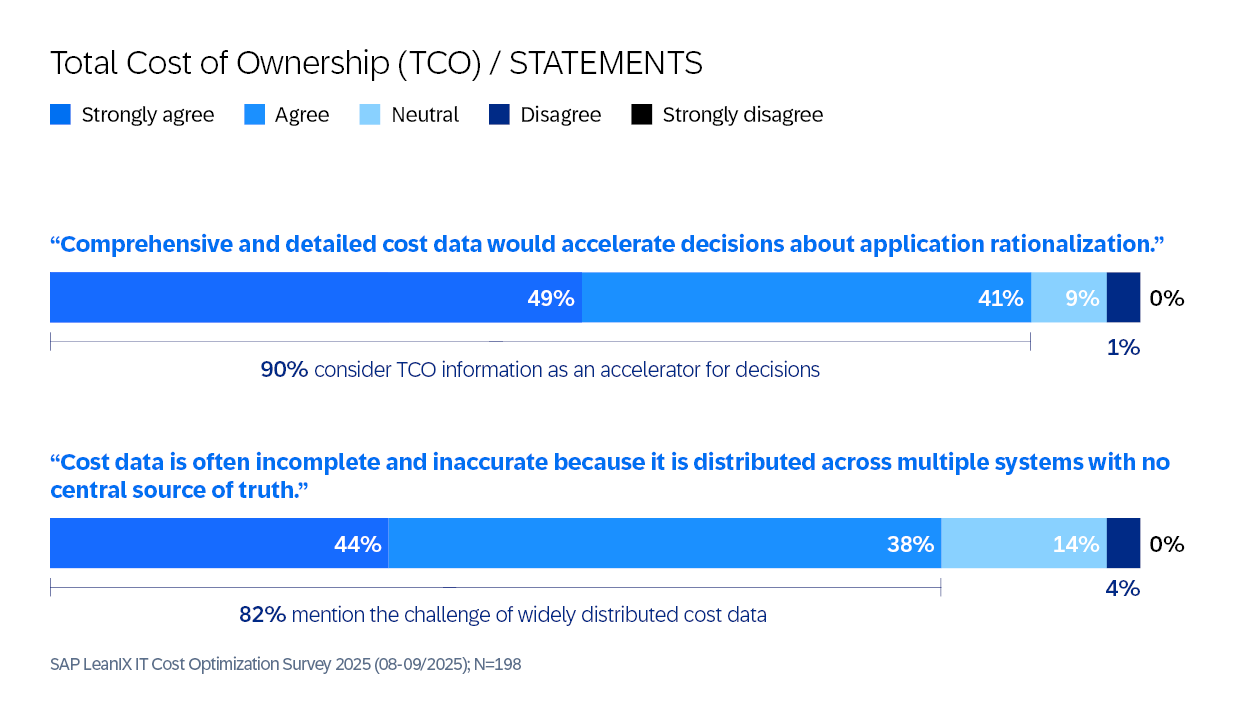
In the absence of one, a company’s existing enterprise architecture solution could serve as the central source of TCO information. Two-thirds of respondents believe this would be a reasonable approach and effectively bring all application data together in one place.
Finally, consolidating all relevant application data—from ownership to TCO—in a single solution offers the additional benefit of improving collaboration between IT and the business. A central, comprehensive data source for all applications can foster a shared understanding of applications within the broader business context. More importantly, by accelerating the decision-making process, it can also enable faster and more targeted optimization of IT spend.
Free downloads: