Elevate your Enterprise Architecture with Artificial Intelligence
Learn moreSAP LeanIX Customers
A growing list of industry leaders and organizations of all sizes who trust in SAP LeanIX
See Full ListMaximize market potential through a partner program offering LeanIX solutions tailored to your business model.
Learn moreTake your capabilities to the next level and arm yourself with the knowledge you need
See all resourcesGet to know everything about what a Target Architecture is, how to define your Target Architecture and how SAP LeanIX can help defining it.
In the world of business and IT, the objective is continuous improvement. However, there can be no improvement without setting benchmarks. Within the realm of enterprise architecture (EA), a target architecture represents reaching a desired future state.
Enterprise architecture is a discipline that is devoted to the alignment of business and IT. It offers a holistic overview of the enterprise where every business capability is mapped alongside its underlying technologies to lead the strategic decision-making behind business transformation.
Where enterprise architecture is a practice, target architecture is a concept. EA sits at the heart of strategy and execution.
A target architecture sets the framework for planning, assigning resources, and streamlining activities to reach a desired future state. In essence, the target architecture is the blueprint for both enterprise architects and project managers to follow.
Target architectures are created to harmonize future business requirements with best-fit technology to support operational goals.
To do so, enterprise architects must consider every artifact across the IT landscape, including business capabilities, components, applications, user groups, data objects, and more. Then, they need to roadmap the impact various changes will make during a transformation project.
The motivations behind creating a target architecture vary, but they apply to every organization and industry. Any company looking to improve its internal capabilities and processes, customer relationships, or operating model, will benefit from a clearly defined target architecture. Since all businesses are pursuing growth by way of technology, there will always be a goal to achieve.
To grow in today’s digital age means to transform. Three of the most common business transformation projects that serve as motivation for creating a target architecture are:
1. Cloud migration
Many of today’s leading modern enterprises are in the process of shifting to a cloud-native world or have already completed doing so. The advantages are clear: superior agility, scalability, efficiency, and a reduction in overhead costs. However, moving to the cloud also involves making changes to the IT architecture.
Companies need the talent and tools in place to take advantage of this speed and scalability, while at the same time complying with data privacy regulations and maintaining governance.
By not taking a proactive approach, these organizations will become unattractive to developers who feel like they will be bogged down with restrictions.
2. ERP rollout
Companies running on legacy enterprise resource planning (ERP) systems miss out on critical features to streamline operational efficiencies and lack the proper customer support needed to thrive.
But rolling out a new ERP is no walk in the park. It’s a daunting and complex task that requires careful planning and oversight from stakeholders across the business to outline a target architecture.
Leveraging enterprise architecture is critical for teams to conduct a rapid assessment of legacy ERP architecture, identify opportunities, and tackle the associated challenges.
By understanding the key phases of your ERP migration, and how EA plays into each step, stakeholders can reduce risk, save time and money, and accelerate innovation.
3. Mergers and acquisitions
From blending disparate workforces to onboarding applications and integrating technologies, the M&A process is one of the most common yet multifaceted of all business transformations.
In a digital context, time and precision are essential components of the post-merger integration process guided by a jointly defined target architecture.
Outside of business transformation activities, companies may be motivated to create a target architecture to save costs and reduce risks through application rationalization.
Though a target architecture can’t be defined until a thorough analysis of existing applications occurs, this is another driver for doing so.
Visual-first target architecture planning is an approach that starts with a diagram of the desired future state, then works backward to derive transformation data, identify gaps, and align stakeholders on what needs to change. The starting point is the target, not the baseline.
Traditional target architecture planning typically begins from the current state outward: analyze the baseline, assess each application against the TIME model, then design the future state. This approach works, but it has a friction point.
Defining the future architecture requires close collaboration between business stakeholders who understand the outcomes and technical architects who understand the current landscape. When that collaboration happens through complex notation models: ArchiMate layers, UML component diagrams, formal metamodels, the discussion becomes inaccessible to business stakeholders and slows down.
Visual-first planning reverses the starting point. Enterprise architects design the target state as a diagram, using views that business and IT stakeholders can interpret directly. From that diagram, transformation data is derived and maintained automatically: the gap between current state and target state becomes visible without requiring a separate analysis layer. Decisions are anchored to the visual and documented as architecture decisions linked to specific diagram elements.
The practical flow is three steps:
| Step | What happens | Who is involved |
| Design | Model the desired future state in a diagram, defining the target applications, capabilities, and relationships | EA team, business stakeholders, programme leads |
| Compare and decide | Identify the gaps between current and target state; evaluate options visually; document architecture decisions linked to diagram elements | EA team, application owners, business sponsors |
| Plan and take action | Translate architecture decisions into projects and epics on the roadmap; adjust timelines and priorities directly in the planning view | EA team, project managers, portfolio teams |
The value of the visual-first approach is that it compresses the planning cycle. Cross-functional stakeholders can engage with the future state directly, without needing to understand formal modelling notation. Architecture decisions are made during the planning session rather than after a separate documentation phase. The roadmap reflects real decisions, not estimated future states.
For organizations running transformations, the speed of architecture decisions, not the notation complexity behind them, determines how quickly program milestones are reached. Visual-first planning is built for that constraint.
SAP LeanIX Architecture and Road Map Planning is built around the visual-first approach. Architecture Guidance continuously analyzes the EA inventory and surfaces insights during planning: flagging gaps, identifying applications that require attention, and guiding architects through next steps.
The EA Assistant adds natural language Q&A, allowing architects to retrieve relevant data and architecture decisions in real time during planning sessions.

Before enterprise architects can create a target architecture, they must have a thorough understanding of their application inventory and baseline architecture. The baseline architecture represents the "as-is" current state of the IT landscape.
Companies with a mature enterprise architecture practice will have their IT information clearly documented and accessible using a tool like SAP LeanIX. Unfortunately, for many organizations, critical information is disorganized and scattered across various divisions, file types, and data silos.
EAs at these companies must manually collect data by interviewing relevant stakeholders throughout the organization. They then compile and verify that information to capture the baseline architecture, which is likely to change before a target architecture can even be created.
The anchor of any target architecture is its applications. After gathering the information to understand the "as-is" state, it's time to decide the fate of current applications. A useful method to do so is Gartner's TIME model, which helps organizations decide whether to tolerate (T), invest in (I), migrate (M), or eliminate (E) the applications hosted in its baseline architecture.
Criteria will vary based on the organization and its needs, but here are our recommendations for best practices:
Tolerate: The application has high technical quality, there is not a lot of time or money invested in support, but it provides a certain amount of value. Since the value is not negligible, is used, and doesn't cost a lot to maintain, the application should be left alone and considered for future improvement.
Invest: The application is stable, doesn't require much support, and is architected well. The business uses it and there is an attributable and recognizable value. These are the applications worth investing in, yielding even better returns or seeing a further reduction in costs.
Migrate: This option is for applications that are low quality but provide high value to the business. Several decisions can be made when pursuing application migration: shift users and data to an existing application and discard the instance (in the event of redundant applications); blend two applications under a common version or platform; merge multiple applications (either physical, logical, or both); or exchange application with an off-the-shelf commercial solution.
Eliminate: These applications provide no business value, are unused or used minimally, or are based on obsolete software.
After motivations are understood, desired business outcomes are clear, and the baseline architecture is set, it’s time to map out and define the target architecture. This can be accomplished with four simple steps: Plan, Decide, Execute, and Manage.
Get started by establishing the overall business objective(s) and ensuring all stakeholders are on board and moving in the same direction. From there, it's time to break down the objective(s) into tangible IT initiatives, such as migrating specific applications and processes to the cloud.
This information will allow enterprise architects to forecast high-level changes to the IT infrastructure and get a fundamental grasp of the impacts that will need to be addressed. It's critical to put timelines in place so that teams are accountable and activities follow the plan as agreed.
Once the plan is in motion, it's time to further segment IT initiatives into executable projects and epics. If the internal resources don't exist to meet the deadlines laid out in the planning phase, organizations may bring on consultants to help see their project through.
At this point, enterprise architects can begin visualizing how short-term initiatives align with long-term business objectives. Doing so will empower stakeholders to forecast how future changes to applications and IT components will affect business capabilities, and shape key decisions in prioritizing actions toward achieving the target architecture.
Transformation activities are underway. EAs should monitor the progress of evolving business objectives while measuring stages of completion on individual projects. Regular communication amongst team members is critical to keep items moving forward and on track with the plan.
All architectural changes should be actively documented and reflected in the IT repository to maintain data quality. Although speed is essential, security and proper execution are even more imperative. Ensure projects are broken out into manageable chunks so that nothing breaks.
Changes to the IT infrastructure will almost always impact multiple business capabilities and the teams that support them. Transitioning from a baseline to a target architecture cannot happen within a bubble.
Engage these stakeholders early to communicate the reasons behind changes and the value they will bring to the organization. Decisions should be data-backed and communicated transparently, reassuring users and keeping the program on track.
In today's world, the symbiotic relationship between business and technology means that any change can have far-reaching consequences. Organizations must transform to grow, and a clearly defined target architecture is what makes that transformation purposeful rather than reactive.
It provides the North Star that aligns strategic IT and business decisions and keeps every stakeholder accountable to the same future state.
Quickly turn data into insight and insight into tangible results!
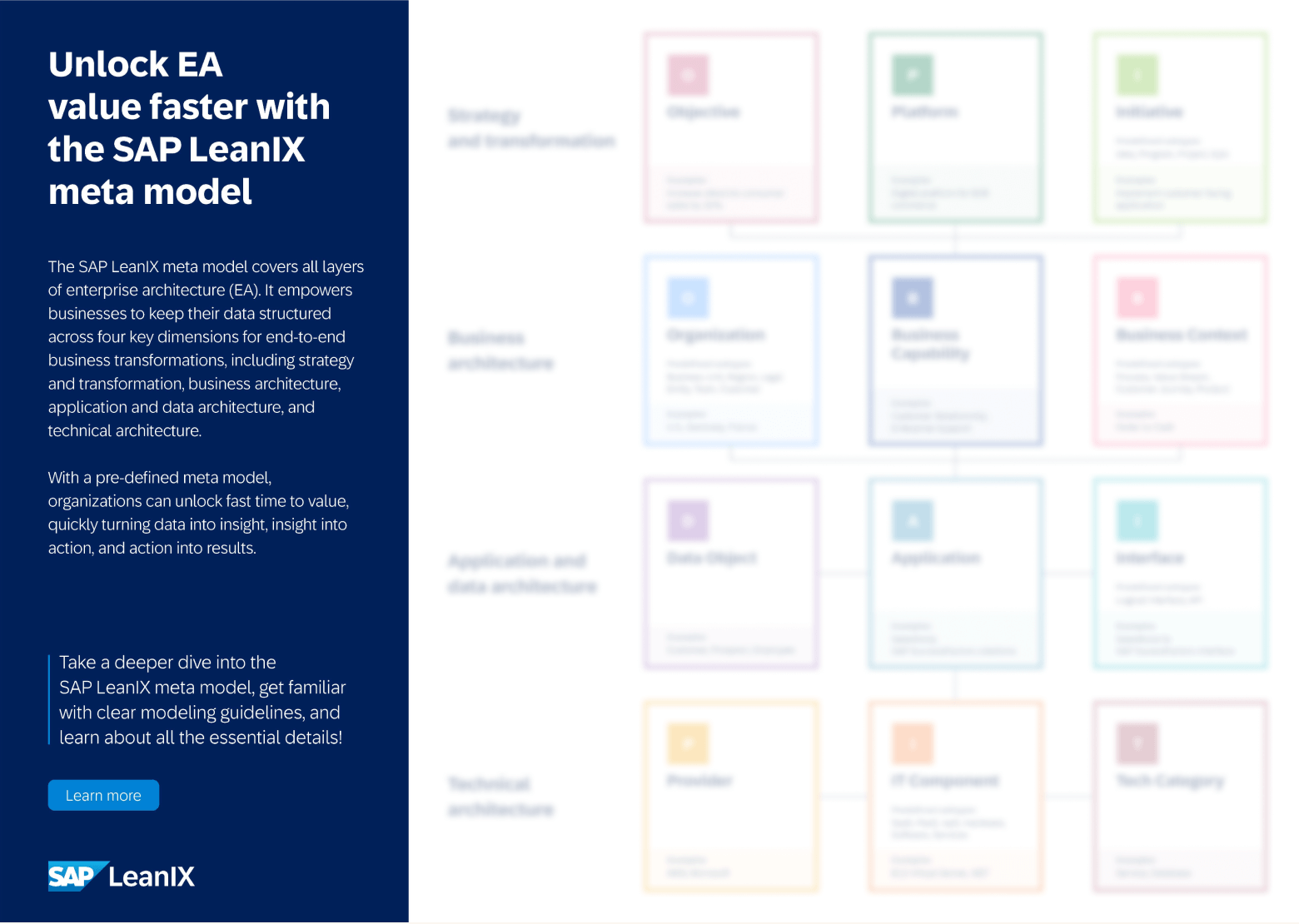
See the full picture across Strategy & Transformation
See the full picture across Business Architecture
See the full picture across Application & Data Architecture
See the full picture across Technical Architecture
What is the difference between a current state and target architecture?
The current state (baseline) architecture documents what exists today: the applications, capabilities, and relationships in the IT landscape at a given point in time. A target architecture defines what should exist in the future to support strategic objectives. Together, they form the transformation frame. The gap between the two is what the architecture program must close.
What is the difference between a target architecture and a roadmap?
A target architecture defines the destination: the future-state structure of applications and capabilities the organization is building toward. A roadmap defines the journey: the sequence of projects and decisions needed to get there. The target architecture answers "what does done look like?" while the roadmap answers "how do we get there, and by when?" A target architecture must be defined before a credible roadmap can be built.
Who creates a target architecture?
Target architectures are owned by the enterprise architecture team, typically led by a chief architect or EA practice lead. Business stakeholders contribute the requirements that shape the future state; IT teams provide constraints around technical feasibility and integration. The most effective target architectures are co-developed across these groups rather than handed down from a single function.
How often should a target architecture be reviewed?
Target architectures should be reviewed at least annually, and more frequently during active transformation programs. Business priorities shift, acquisitions happen, and technology options evolve. A target architecture that is not updated becomes a constraint rather than a guide. Most mature EA teams tie reviews to planning cycles: quarterly for major transformation programs, annually for the broader landscape.