Elevate your Enterprise Architecture with Artificial Intelligence
Learn moreSAP LeanIX Customers
A growing list of industry leaders and organizations of all sizes who trust in SAP LeanIX
See Full ListMaximize market potential through a partner program offering LeanIX solutions tailored to your business model.
Learn moreTake your capabilities to the next level and arm yourself with the knowledge you need
See all resourcesA digital twin of an organization is defined as a dynamic, continuously updated model of an enterprise's IT landscape, capabilities, and processes.
A digital twin of an organization, also referred to as a DTO or organizational digital twin, is a real-time, data-driven model of how an organization operates. It connects applications, business capabilities, processes, data flows, and organizational structures into a single living model that reflects the current state of the enterprise and can be used to model future states.
The concept originates from manufacturing, where physical assets are mirrored in software to monitor performance and predict failures. Applied to organizations, the physical asset is replaced by the enterprise itself: its technology landscape, its capability structure, and the relationships between them.
Gartner defines the DTO as "a dynamic software model of any organization that relies on operational and/or other data to understand how an organization operationalizes its business model, connects with its current state, responds to change, deploys resources and delivers expected value." For enterprise architects, this translates directly to the application portfolio, business capability map, and the dependencies between them.
Traditional EA produces architecture diagrams, including ArchiMate models, Visio drawings, and PowerPoint slides, that represent the organization at a point in time. These are valuable for planning but age quickly. A department restructures, an application is decommissioned, a new SaaS tool gets adopted without central approval. Within weeks, the diagram no longer reflects reality.
A digital twin of an organization solves this by replacing static diagrams with a continuously updated model fed by live data. Changes in the IT landscape propagate into the model automatically, and the architecture team moves from maintaining documentation to governing a live system. The practical difference is significant: with a static model, an EA team can describe what the organization looked like six months ago. With a DTO, they can describe what it looks like today and simulate what it will look like after a proposed change.
Manufacturing digital twins mirror physical assets, including turbines, production lines, and supply chains, relying on sensor data and IoT connectivity to reflect the physical world in software. Organizational digital twins mirror the enterprise itself. The “sensors” are the data sources that feed the model: configuration management databases, SaaS usage logs, business capability assessments, process execution data, and application fact sheets.
The output is not a simulation of a machine but a model of how the organization uses technology to deliver business outcomes. This is precisely why the approach has moved from the factory floor to the boardroom.
The volume and pace of change in enterprise IT has made static architecture documentation untenable. The average large enterprise runs several hundred applications, and cloud adoption, SaaS proliferation, and AI agent deployment are accelerating the rate at which the landscape changes. Architecture teams that rely on manual documentation cannot keep pace with that velocity, and the gap between the documented architecture and operational reality is where transformation programs run into avoidable risk.
Three forces are converging to make the DTO timely.
Data availability has reached a tipping point. Modern EA management platforms can automatically discover applications, ingest CMDB data, and pull SaaS usage data. The raw material for a digital twin exists and is increasingly automated. The barrier is no longer data collection but model governance.
Regulatory pressure is increasing the cost of poor architecture visibility. DORA, NIS2, and similar frameworks require organizations to demonstrate a clear, current view of their technology landscape and its risk posture. A digital twin provides audit-ready documentation by design, not by effort.
AI governance is creating a new accountability gap. As organizations deploy AI agents alongside traditional applications, they need a model that captures AI assets and their dependencies. The organizational digital twin is becoming the governance layer for AI deployment: the place where AI components are registered, assessed, and monitored alongside the rest of the landscape.
A digital twin of an organization is not a single technology. It is a model assembled from several interconnected layers, each of which depends on the others to be useful. Understanding these layers helps EA teams prioritize where to invest first and how to extend the model over time.
The IT landscape layer captures all applications, IT components, interfaces, and their technical relationships. This is the foundation of the DTO and the layer that most organizations build first. It includes not just what applications exist but how they connect: which systems integrate with which, which processes they support, and which business capabilities they enable.
The business capabilities layer maps organizational capabilities, meaning the things the business must be able to do, to the technology that supports them. A business capability map shows which applications support which capabilities, making it possible to assess the impact of a technology change on business operations before making it.
The process and data flow layer adds the operational dimension: how work moves through the organization, which systems handle which steps, and where data originates and flows. For EA teams working alongside process teams, this layer connects the IT landscape to operational performance. It is where the DTO links most directly to process intelligence platforms.
The governance layer captures ownership, lifecycle status, compliance posture, and risk assessments for each asset. This is the layer that makes the DTO actionable for governance and compliance teams: a managed system with clear accountability, not a static map.
Together, these four layers produce a model useful for decision-making, not just as documentation.

Success Kit
Everything you need for quick time-to-value and long-term success through EA.
Building a digital twin of an organization follows four steps. These are not strictly sequential, as most organizations run them in parallel as the model matures, but they provide a clear framework for where to start and what to build toward.
The DTO begins with an accurate inventory of the IT landscape. For most organizations, this means ingesting data from existing CMDBs, SAP system landscapes, SaaS discovery tools, and manual fact sheets. The goal at this stage is coverage rather than perfection: a DTO with 80% coverage that is kept current is more valuable than a 100% accurate snapshot that ages immediately.
Once the IT landscape is documented, the next step is connecting applications to business capabilities. Business capability maps define what the organization does: plan, procure, manufacture, service, finance. Each capability is then linked to the applications that support it, transforming the inventory from a list of assets into a model of the business. This connection makes it possible to answer questions like: which applications do we need to keep running if we restructure the procurement function? or which capabilities are currently under-supported by our technology?
With the current state established, the DTO enables scenario planning. EA teams can model a proposed cloud migration, an M&A integration, or an application rationalization program in the twin before committing to changes in the real landscape. Impact analysis shows which capabilities, processes, and dependencies are affected by a proposed change. Instead of relying on architecture diagrams to communicate change implications, transformation leads can run scenarios in the model and share the results. The conversation shifts from “we think this will be affected” to “here is what the data shows.”
A digital twin is only valuable if it reflects reality. Governance processes, including ownership assignment, regular review cycles, and automated data refresh from connected CMDBs and cloud APIs, keep the model current. The model does not need to be updated manually every time something changes: automated integrations propagate changes into the DTO as they happen. What governance ensures is that the model’s scope and quality are actively managed, not allowed to drift.
The architecture of an organizational digital twin follows four layers, each building on the one below. Knowing how these layers relate to each other helps teams understand where problems originate and where to invest to increase the model’s reliability.
The data layer holds the raw inputs: application data from CMDBs, SaaS usage data, process execution logs, business capability assessments, and configuration data from SAP and non-SAP systems. Data quality here determines model quality everywhere above. This is why data governance is the most important and most underestimated part of a DTO program.
The model layer holds the structured representation of the organization, covering applications, capabilities, processes, interfaces, and the relationships between them. This is the fact sheet graph: every asset is a node, every relationship is an edge, and the graph is the model that all analysis and governance operate against.
The simulation layer enables change modeling: what happens to capabilities if an application is decommissioned? Which systems are affected by a cloud migration? What does the landscape look like after an M&A integration? Scenario planning and impact analysis tools operate at this layer, turning the static model into a forward-looking decision instrument.
The visualization layer surfaces the model to stakeholders through architecture diagrams, capability heat maps, roadmaps, and executive dashboards. Different stakeholders need different views of the same underlying model: the enterprise architect needs the dependency graph; the CIO needs the risk dashboard; the transformation lead needs the roadmap. The strength of the visualization layer determines how broadly the DTO gets used beyond the EA team.
The terms digital twin and simulation are sometimes used interchangeably, but they describe fundamentally different things. The distinction matters for how organizations set expectations and design their governance approach.
A simulation is a model run to test a specific scenario under defined assumptions. It produces an output, such as projected performance, predicted failure rates, or modeled costs, and then ends. A simulation answers a specific question at a point in time, then it is done.
A digital twin is a persistent, continuously updated model that remains synchronized with reality over time. It can run simulations, but that is not its primary purpose. Its primary purpose is to provide an accurate, current representation of the organization that can be used for ongoing decision-making, governance, and scenario planning.
In practice: a simulation is a calculation you run once. A digital twin is a living model you maintain and consult continuously. For enterprise architects, this distinction matters because it defines the operating model: a digital twin requires data governance, ownership assignment, and continuous refresh in a way that a simulation does not. Organizations that treat their DTO as a one-time simulation project rather than an ongoing operational model consistently underperform on the benefits they set out to achieve.
The organizational digital twin delivers the most direct value in situations where transformation decisions carry high risk and where the cost of discovering hidden dependencies mid-program is significant. The following use cases represent the most common applications in EA practice today.
Cloud migrations fail most often not because of technical problems but because of incomplete visibility into what needs to move, what depends on what, and what can be decommissioned. A digital twin provides the dependency map that makes migration planning reliable. Before the migration begins, the DTO shows which applications are cloud-ready, which carry technical debt, and which have dependencies that complicate migration sequencing. During the migration, the model tracks progress against the target architecture. After completion, it reflects the new state immediately, without requiring a separate documentation effort.
Application rationalization follows the same pattern. The DTO makes visible which applications overlap in function, which are underutilized, and which can be consolidated. This is evidence that is difficult to assemble manually but available by design when the model is current.
M&A integration is one of the highest-stakes architecture scenarios an EA team faces. Two organizations, each with their own IT landscape, must be assessed for overlap, integration complexity, and target architecture design, often under time pressure and with limited access to the acquired company’s systems. A digital twin accelerates this assessment: the acquiring organization’s DTO provides the baseline, and as data from the acquired company becomes available, it is ingested into a parallel model. Comparison and integration scenario planning can begin before the legal close, compressing a process that typically takes months of manual analysis.
When an organization restructures, merging business units, outsourcing functions, or redesigning operating models, the technology implications are frequently underestimated. The capability map shows which capabilities are owned by the affected business units, and the application layer shows which applications support those capabilities. Impact analysis identifies which systems need to be reconfigured, reassigned, or decommissioned as organizational ownership changes. This analysis is most useful before the restructuring is announced rather than after it is in motion.
DORA and NIS2 require financial institutions and critical infrastructure operators to demonstrate a continuously maintained, accurate view of their technology landscape and its risk posture. A digital twin satisfies this requirement by design: the model is current, ownership is assigned, and risk posture is tracked. Audit responses that previously required weeks of manual data collection can be generated directly from the DTO in hours. This is a tangible operational benefit for compliance teams that previously treated architecture documentation as a one-time audit exercise.
Every DTO program encounters the same set of recurring challenges. Knowing them in advance does not eliminate them, but it allows organizations to address them as design decisions rather than as surprises.
Data readiness is the most consistent bottleneck. The quality of a digital twin depends on the quality of its data inputs. Organizations with fragmented or inconsistent CMDBs, undocumented SaaS usage, or incomplete application inventories need to invest in data quality in parallel with building the model. The practical approach is to start with what exists, identify the highest-priority gaps, and close them incrementally, rather than waiting for perfect data before beginning.
Organizational adoption is the most underestimated challenge. A digital twin is only as current as the people who maintain it. Application owners need to keep their fact sheets accurate; process owners need to flag changes; EA teams need to enforce governance. Getting adoption requires making the model genuinely useful to contributors, so that maintaining it is in their interest, not just the EA team’s.
Scope management determines whether the program delivers early value or stalls in ambition. The temptation when building a DTO is to model everything at once. In practice, organizations that start with a focused scope, such as a specific business domain or a specific transformation program, and expand from there get to value faster and sustain the model better than those who attempt a full-enterprise model from day one.
Building a digital twin of an organization is not a one-time project. It is an ongoing practice. Organizations that treat it as such move from reacting to architecture surprises to anticipating them. The investment compounds: each improvement in data quality, model coverage, and governance process makes the next transformation program faster, lower-risk, and better informed. For enterprise architects, the DTO is the shift from being a documentation function to being a decision-support function for the business.
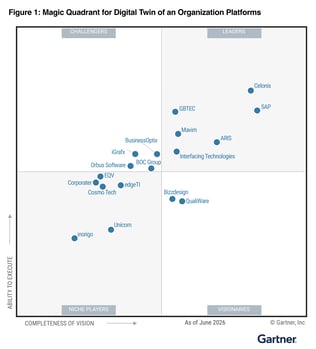
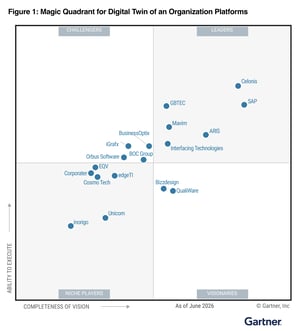
Download your complimentary copy of the report
and see how SAP solutions were evaluated in this category
How is a digital twin of an organization different from an application portfolio?
An application portfolio is one layer of the DTO: the inventory of applications and their attributes. A digital twin connects that inventory to business capabilities, processes, dependencies, and organizational ownership, and adds the ability to simulate change and govern the model over time. The portfolio is a component of the twin, not a substitute for it.
How long does it take to build a digital twin of an organization?
A working model with meaningful coverage can typically be established in 8–12 weeks when automated discovery tools are used and existing CMDB data is available. Full coverage, including business capability mapping and scenario planning capability, typically takes 3–6 months depending on the size and complexity of the landscape. The model improves continuously after that, so the value compounds over time rather than being realized all at once.
What data do we need before starting?
The minimum starting point is an application inventory, even a spreadsheet. Automated discovery tools can enrich it from there. A CMDB export, SaaS usage data, and existing architecture documentation accelerate the build significantly. Perfect data is not a prerequisite: the model is built iteratively, and the act of building it typically surfaces the data quality gaps that most need addressing.
Who owns the digital twin: IT or the business?
The EA team typically owns and governs the model. Practice confirms the value: “More than 2,000 people across our organization use LeanIX as a living map of the enterprise, contributing fresh data regularly and enabling us to make quick, informed decisions.” — Senior Enterprise Architect, Construction, 10B–30B USD · Gartner Application owners across IT and the business contribute data and maintain their areas. Business architects bridge the capability layer between IT and business stakeholders. Executive sponsorship from the CIO is the most reliable predictor of successful DTO adoption: it signals that the model is used for real decisions, not just documentation.
Is the organizational digital twin only relevant for large enterprises?
The DTO scales with organizational complexity. For smaller organizations with a manageable application portfolio and limited transformation activity, a manually maintained EA model may be sufficient. The twin’s benefits, including continuous update, automated dependency mapping, and scenario planning, become most valuable as portfolio size, transformation velocity, and governance requirements grow. Most EA teams find the investment warranted once they are managing more than a few dozen applications across multiple business domains.
Gartner, Inc. Magic Quadrant for Digital Twin of an Organization Platforms. Marc Kerremans, David Sugden, etl. 27 July 2026.
Gartner and Magic Quadrant are trademarks of Gartner, Inc. and/or its affiliates. Gartner does not endorse any company, vendor, product or service depicted in its publications, and does not advise technology users to select only those vendors with the highest ratings or other designation. Gartner publications consist of the opinions of Gartner’s business and technology insights organization and should not be construed as statements of fact. Gartner disclaims all warranties, expressed or implied, with respect to this publication, including any warranties of merchantability or fitness for a particular purpose.
Free Analyst Report
2026 Gartner Magic Quadrant for Digital Twin or an Organization Platforms
Download Report