Elevate your Enterprise Architecture with Artificial Intelligence
Learn moreSAP LeanIX Customers
A growing list of industry leaders and organizations of all sizes who trust in SAP LeanIX
See Full ListMaximize market potential through a partner program offering LeanIX solutions tailored to your business model.
Learn moreTake your capabilities to the next level and arm yourself with the knowledge you need
See all resourcesThe benefits of a digital twin of an organization include real-time IT visibility, faster transformation decisions, and continuous governance.
The organizational digital twin changes how enterprise architects and IT leaders work by replacing static, manually maintained architecture models with a continuously updated representation of the IT landscape.
The benefits are most visible in four areas: decision speed, transformation risk, collaboration, and governance continuity.
An enterprise architecture model that is updated quarterly reflects the IT landscape as it existed three months ago. For organizations running active transformation programs, that lag creates a persistent gap between the architecture on paper and the architecture in production.
The digital twin eliminates that gap by connecting the model directly to live data sources, including configuration management databases, cloud infrastructure APIs, and application metadata, and updating the model continuously as the landscape changes.
For an enterprise architect managing an application portfolio of several hundred applications across multiple business units, real-time visibility means that a decommissioning event in one system is reflected in the model before the next architecture review, not discovered as an inconsistency weeks later. The model is always current because it is always connected.
Architecture decisions, including which applications to retire, which platforms to consolidate, and how to sequence a migration, require accurate information about dependencies, ownership, and impact.
When that information lives in spreadsheets, SharePoint documents, or manually updated architecture tools, decision-makers face a choice between speed and accuracy: move fast on incomplete information or slow down to verify the current state.
The digital twin removes that trade-off. Impact analysis runs against a model that reflects the current landscape, not a version that was accurate when it was last updated. A CIO evaluating cloud migration options can model the target architecture, run dependency analysis against the live application portfolio, and identify integration risks before the program begins, with confidence that the analysis is based on current data.
Transformation programs that fail to account for hidden dependencies, orphaned integrations, or undocumented applications generate rework, delays, and cost overruns. The root cause is usually information quality: the program plan was built on an architecture model that did not reflect operational reality.
The organizational digital twin directly reduces this risk by maintaining an accurate, continuously updated picture of the IT landscape throughout the program lifecycle. As applications are decommissioned, migrated, or reconfigured, the twin updates. Program dependencies are then revalidated against the current state rather than a stale baseline.
Scenario planning within the twin allows teams to model the target architecture before any change is made, identifying dependency conflicts and sequencing risks in simulation before they appear in production.
Enterprise architecture decisions affect both business capability delivery and technical infrastructure. When the architecture model lives only in specialist EA tooling, business stakeholders cannot engage directly with the information they need to make informed decisions about capability investments, process changes, or organizational restructuring.
The digital twin makes architecture information accessible to business stakeholders through visual capability maps, application portfolio views, and impact simulations that do not require specialist EA training to interpret.
A CFO evaluating a financial systems consolidation program can see the current application landscape for finance capabilities, understand which applications serve which processes, and participate in the investment decision with accurate information, rather than relying on summaries prepared by the EA team.
Architecture governance in most organizations operates through periodic review cycles, including quarterly board reviews, annual portfolio assessments, and project-gate architecture approvals. Between reviews, the architecture drifts. New applications are onboarded without formal approval. Integrations are built outside the standard pattern. Technical debt accumulates.
The organizational digital twin supports continuous governance by providing a persistent, up-to-date model against which every change can be assessed.
Governance rules, including technology lifecycle policies, integration standards, and application ownership requirements, can be applied continuously to the twin rather than checked manually at review intervals. Deviations from architecture standards are surfaced as they occur, not discovered in the next annual review.

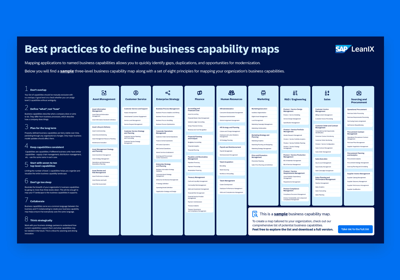
Poster
This poster helps you create the perfect business capability map for your organization with visual capability mapping examples.
Traditional enterprise architecture practice relies on manually maintained models, periodic data collection, and architecture review processes that operate on cycle times measured in weeks or months. The organizational digital twin does not replace the principles of enterprise architecture; it changes how those principles are operationalized.
| Dimension | Traditional EA | Digital twin of an organization |
| Model currency | Updated manually, periodically — typically weeks or months behind operational reality | Continuously updated from live data sources — reflects the current landscape |
| Data collection | Manual interviews, surveys, and configuration exports | Automated extraction from CMDBs, cloud APIs, and application metadata |
| Decision basis | Architecture reviews based on the last model update | Impact analysis based on the current model |
| Governance | Periodic review cycles | Continuous monitoring against defined architecture standards |
| Stakeholder access | Architecture team only — specialist tooling required | Accessible to business stakeholders through visual interfaces |
| Change impact | Assessed at project-gate reviews | Modeled in real time before changes are made |
The shift from traditional EA to the organizational digital twin is not primarily a technology change; it is a change in how frequently and how automatically the architecture model is updated, and how broadly that model is used in decision-making.
Evidence-based architecture decisions: Decisions are grounded in the current landscape, not in a model that reflects a historical state; impact analysis, dependency mapping, and scenario planning all operate on current data.
Reduced transformation risk: Hidden dependencies and undocumented integrations are surfaced in simulation before they cause disruption in production change programs; this is particularly critical for cloud migration and application rationalization programs.
Faster governance: Continuous model currency means governance can operate at the pace of change rather than the pace of review cycles.
Greater business-IT alignment: Accessible visual models allow business stakeholders to engage directly with architecture information, reducing the translation layer between EA teams and decision-makers.
Reduced manual data collection burden: Automated extraction from live data sources reduces the time EA teams spend on data collection and model maintenance.
Data source dependencies: The twin is only as accurate as the data sources feeding it; if configuration data in the CMDB is incomplete or inconsistent, the twin inherits those inaccuracies; data quality is a prerequisite, not a benefit.
Integration complexity: Connecting the twin to live data sources across a heterogeneous IT landscape requires integration work that varies in complexity depending on the existing infrastructure; organizations with fragmented or undocumented landscapes face a higher initial investment.
Governance overhead: A continuously updated model requires governance structures to manage access, maintain model ownership, and ensure that automated updates do not introduce errors; the twin creates governance requirements as well as supporting them.
Change management: Shifting from periodic architecture reviews to continuous, data-driven governance requires process and cultural change that goes beyond tooling; EA teams and business stakeholders need to adapt how they engage with architecture information.
Recognizing these limitations is not a reason to avoid the digital twin. It is a reason to plan for them. The next section identifies the specific organizational challenges that the twin directly resolves, which helps scope where the investment is most justified.
The organizational digital twin directly addresses four challenges that limit the effectiveness of traditional enterprise architecture:
Architecture model drift: in traditional EA practice, the architecture model diverges from operational reality over time as changes are made without updating the model; the digital twin prevents drift by updating continuously from live data sources.
Decision-making on stale data: transformation decisions made on the basis of outdated architecture models carry hidden risk; the twin ensures that impact analysis and scenario planning operate on current information.
Invisible dependencies: undocumented integrations and informal application dependencies are among the most common causes of transformation program failure; the twin surfaces these dependencies by deriving them from operational data rather than relying on documentation.
Governance at review pace: periodic review cycles cannot keep up with the rate of change in active transformation programs; continuous governance enabled by the twin applies architecture standards at the pace of change rather than the pace of review.
Solving these challenges in principle is straightforward; delivering on them in practice requires addressing the implementation challenges that most organizations encounter.
Understanding the benefits of the organizational digital twin is different from successfully implementing one. The most common implementation challenges are:
Defining the data scope: The twin can only include what its data sources cover; deciding which systems to connect, which application attributes to capture, and which relationships to model is a scoping decision that significantly affects both the implementation timeline and the ongoing accuracy of the twin.
Data quality remediation: Configuration data in CMDBs and application portfolios is frequently incomplete, inconsistent, or out of date; implementing the twin often reveals data quality problems that must be corrected before the model is accurate enough to support governance decisions.
Stakeholder buy-in for continuous updates: Application owners and business unit leads must provide accurate metadata and respond to model update requests; without organizational commitment to data quality, the twin degrades over time.
Integration with architecture governance processes: The twin is most valuable when it is integrated into existing governance workflows, including project gate reviews, technology lifecycle management, and portfolio investment decisions; adapting those processes to use the twin rather than manually maintained models takes time and change management effort
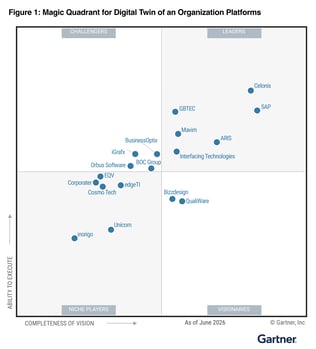
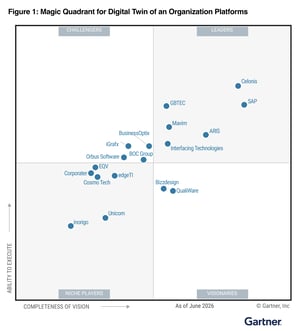
Download your complimentary copy of the report
and see how SAP solutions were evaluated in this category
Do the benefits of a digital twin apply to small organizations, or only large enterprises?
The organizational digital twin scales with the complexity of the IT landscape. For small organizations with a limited application portfolio and simple integration architecture, a manually maintained EA model may be sufficient.
The twin's benefits, including continuous update, automated dependency mapping, and scenario planning, become most valuable as portfolio complexity, transformation velocity, and governance requirements increase.
Most organizations find the investment warranted once the application portfolio exceeds several dozen applications and active transformation programs are running in parallel.
How long does it take to realize the benefits of a digital twin?
Initial benefits, including improved model currency and basic portfolio visibility, are typically realized within the first few months of implementation, once the primary data sources are connected and the model is populated.
More advanced benefits, such as continuous governance, scenario-based impact analysis, and transformation risk reduction, require broader data source integration and process adaptation, which typically takes six to twelve months to fully operationalize.
Is the digital twin beneficial if architecture governance processes are already mature?
What is the difference between a digital twin and an application portfolio management tool?
Gartner, Inc. Magic Quadrant for Digital Twin of an Organization Platforms. Marc Kerremans, David Sugden, etl. 27 July 2026.
Gartner and Magic Quadrant are trademarks of Gartner, Inc. and/or its affiliates. Gartner does not endorse any company, vendor, product or service depicted in its publications, and does not advise technology users to select only those vendors with the highest ratings or other designation. Gartner publications consist of the opinions of Gartner’s business and technology insights organization and should not be construed as statements of fact. Gartner disclaims all warranties, expressed or implied, with respect to this publication, including any warranties of merchantability or fitness for a particular purpose.
Free Analyst Report
2026 Gartner Magic Quadrant for Digital Twin or an Organization Platforms
Download Report