Partner Program

Maximize market potential through a partner program offering LeanIX solutions tailored to your business model.

Learn more
Solution Guide

Is your EA ready for AI?

Generative AI can help organizations achieve a range of business objectives by automating routine tasks, providing data-driven insights, and enhancing creativity.
When thoughtfully and responsibly applied, generative AI can also be used to develop innovative products and services, improve customer engagement, and optimize business processes.

Solution Guide - Is your EA ready for AI?

There is tremendous pressure on companies to adopt generative AI, leverage the competitive advantages of this emerging (and rapidly evolving) technology, and successfully govern it across the organization – all while remaining in compliance with relevant regulations. But as it stands, that's a tall order for most enterprises.

Companies need a way to close this gap so they can take full advantage of generative AI. We believe enterprise architecture solutions offer the best way to do this, making AI easier to adopt and govern. To that end, we’ve added an AI governance extension to our meta model that enables enterprise architects to capture the requisite data about AI in their IT landscape.

The right EA solution for an AI-enabled future

An enterprise architecture practice can provide a structured framework for implementing and governing generative AI effectively across the organization while aligning AI strategies with business goals. When combined with the right EA solution, you will have the visibility, data, and cross-team coordination you need to integrate AI into existing systems and processes, ensure compliance with all relevant regulations, and manage risks associated with AI deployments.

However, your EA solution must have certain capabilities to handle the new challenges generative AI presents.

Provide a complete overview of AI across the organization

Visibility is the foundational requirement for effective AI governance—you can't manage what you can't see. If you don’t know what you have, where it is within your IT landscape, or what it is being used for, it becomes nearly impossible to systematically support, enable, or govern AI adoption. EA solutions need to provide an inventory of all the places generative AI is being leveraged in your IT landscape.

It all starts with the meta model. The meta model in SAP LeanIX defines all the basic elements in your enterprise architecture. Since AI can have an impact on many different aspects of your business, we have created an AI governance extension to the meta model. This extension amends the fact sheets associated with key elements of the meta model, allowing you to account for and track AI at several different levels.

Applications

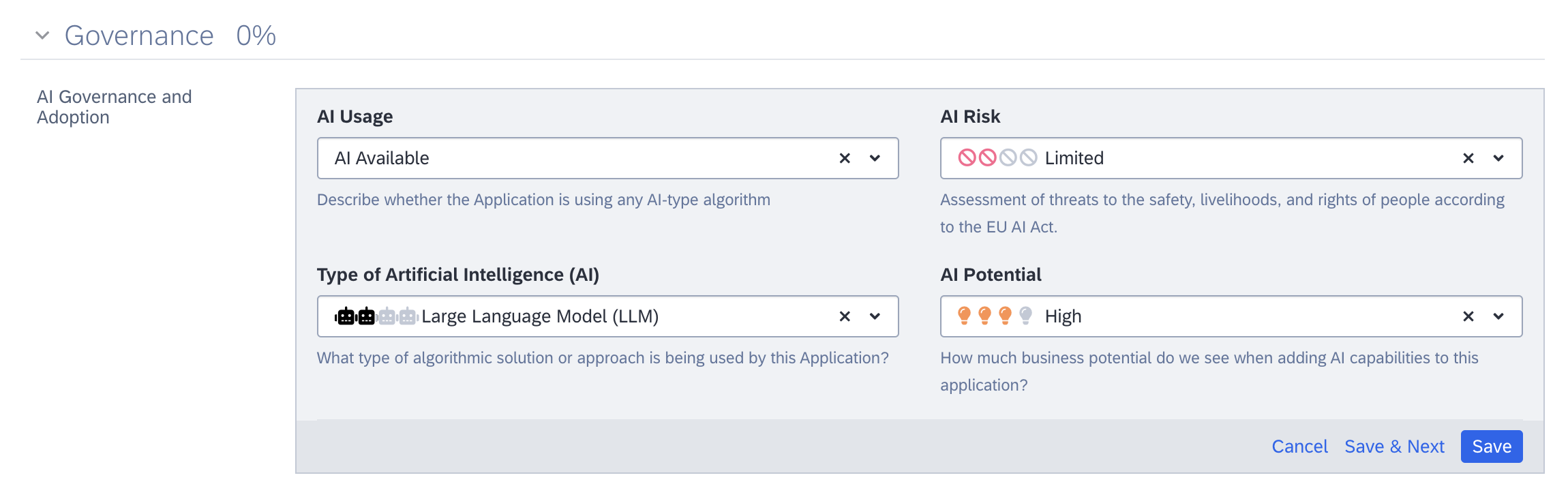
The AI governance extension adds a new subsection¬–AI Governance and Adoption–to the application fact sheet. This subsection allows you to capture whether AI is available for a particular application, the type of AI available, the nature of the risk associated with AI in this instance, and the business potential of leveraging AI with this application.

cafc4fd-governance-section-application
AI Governance and Adoption Subsection on the Application Fact Sheet

Business capabilities

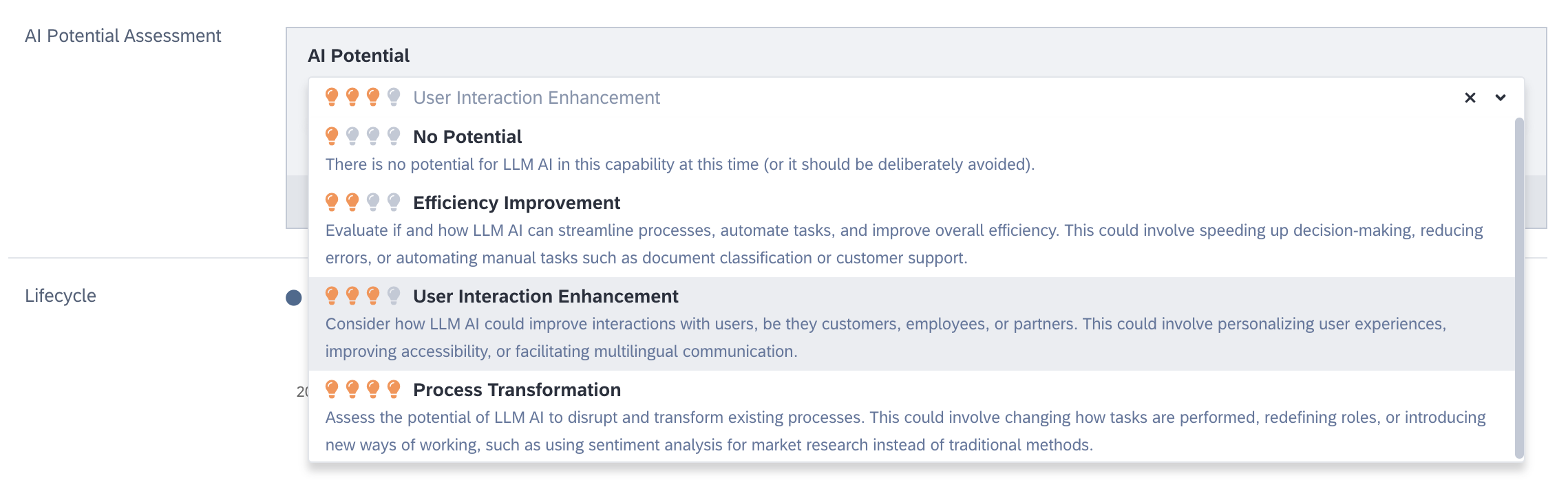
The extension adds a subsection to the business capability fact sheet: AI Potential Assessment. The AI Potential attribute in the fact sheet allows you to indicate the potential business impact of AI on a particular business capability. 

b3149dc-ai-potential-assessment
AI Potential Assessment Subsection on the Business Capability Fact Sheet

IT components

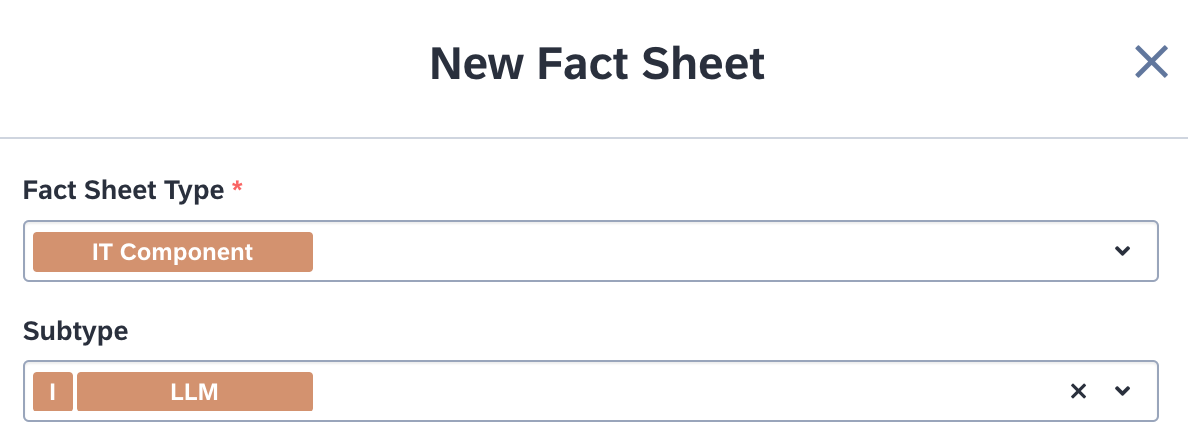
Because many companies have begun developing their own large language models (LLM), the extension adds an LLM subtype to the IT component fact sheet. As a result, you can created dedicated fact sheets for LLMs specifically.

beac98e-llm-subtype-it-component
Creating an IT Component Fact Sheet of the LLM Subtype

Envision your future AI-enhanced state

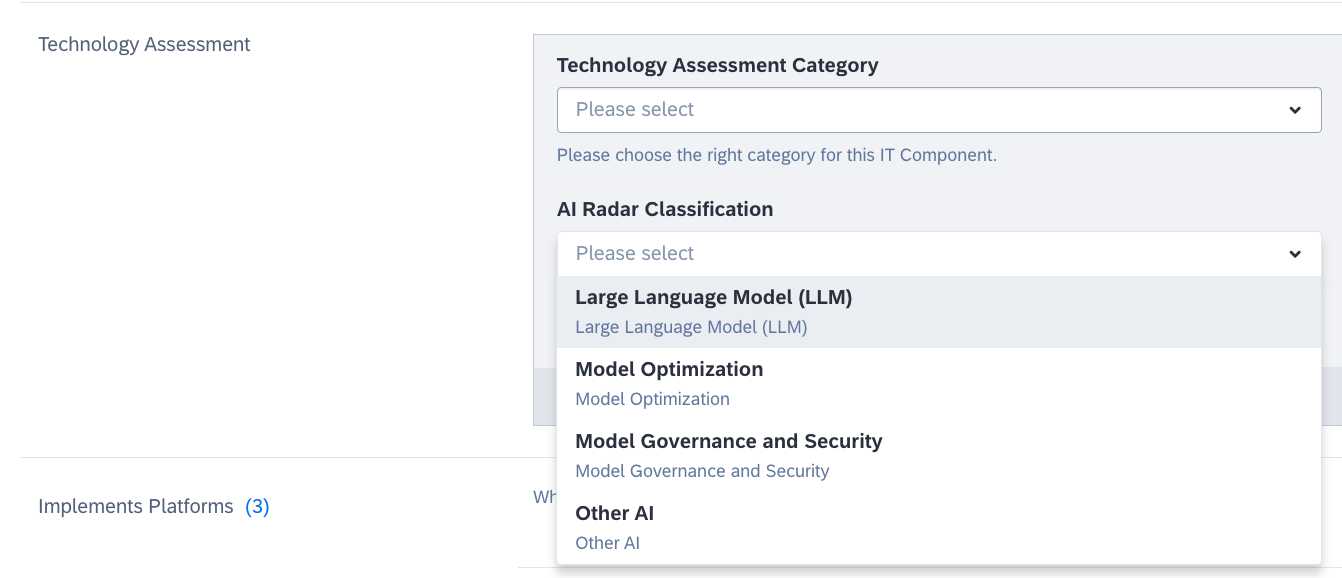
The extension also adds a Technology Assessment subsection to the IT component fact sheet. The AI Radar Classification in that fact sheet makes it possible to visualize AI in your landscape via the Technology Radar Report.

ai-classification
AI Radar Classification Field on the IT Component Fact Sheet

Tracking AI across your landscape – in applications, business capabilities, and IT components -– is a critical first step. Visualizing this information makes it actionable.

For example, using the application landscape report and clustering applications by business capability, you can use the AI Risk view or the AI Potential view to identify, as the names imply, areas of risk and areas for potential in your landscape. From a planning standpoint, you can use this report to consolidate areas where AI offers the highest business potential and prioritize the relevant applications as part of your modernization efforts.

Other reports offer additional insight and opportunity. The IT component matrix report lets you see which AI algorithms or LLMs support which applications. Aside from supporting governance and compliance, this view also allows you to explore paths to optimization or further evolution of you AI strategy. Likewise, the Tech Radar Classification can provide a quick overview of the state of AI adoption. This will reveal and help you prioritize areas where AI adoption can be initiated or accelerated.

Is your EA ready for AI?

Enterprise architecture will be a critical factor in the implementation and governance of generative AI. If you don’t know what you have, where it is within your technology landscape, what it is being used for, or how it is serving the needs of your business (or perhaps more importantly, how it is falling short of serving the business), then it will be nearly impossible to adequately support and enable AI initiatives.

It will also be difficult to ensure you remain in compliance with ever-changing regulations and protect against evolving security risks. With a forward-looking EA practice and the right EA solution, organizations will have a significant advantage in accelerating the use of generating AI across the organization and finding new, innovative ways to leverage this powerful technology to drive growth and transformation.