Elevate your Enterprise Architecture with Artificial Intelligence
Learn moreSAP LeanIX Customers
A growing list of industry leaders and organizations of all sizes who trust in SAP LeanIX
See Full ListMaximize market potential through a partner program offering LeanIX solutions tailored to your business model.
Learn moreTake your capabilities to the next level and arm yourself with the knowledge you need
See all resourcesDigital twin examples in enterprise architecture include cloud migration, M&A integration, application rationalization, and compliance governance scenarios.
The organizational digital twin is applied most consistently in situations where transformation decisions carry high risk and where the cost of discovering hidden dependencies mid-program is significant.
The five examples below represent the most common EA use cases for the DTO in practice.
A cloud migration program that begins without a current, accurate model of the IT landscape typically encounters unexpected integration dependencies, undocumented applications, and legacy platform constraints that were not visible in the initial assessment. The organizational digital twin changes this by providing the architecture baseline that migration planning requires.
In a cloud migration use case, the DTO maps every application in the portfolio against its infrastructure dependencies, integration connections, and business capability ownership.
Before the migration program begins, architects use the twin to run dependency analysis:
which applications share infrastructure with migration candidates,
which integrations will break if a specific application is moved, and which sequencing order minimizes disruption.
The simulation layer tests the migration sequence against the current landscape, identifying dependency conflicts before they become program blockers.
Example: A financial services organization migrating 200 applications to a cloud-native infrastructure uses the organizational twin to build a dependency map that reveals 47 undocumented point-to-point integrations between migration candidates and applications that were not in scope. The program plan is restructured before go-live, avoiding a set of integration failures that would have affected production systems.
Mergers and acquisitions generate one of the most complex EA challenges: integrating two organizations’ IT landscapes while maintaining operational continuity for both. The organizational digital twin accelerates this post-merger integration process by making both landscapes visible and by enabling simulation of integration scenarios before any systems are changed.
In an M&A integration use case, the DTO is built for both organizations immediately post-close, mapping applications, capabilities, and integrations across both portfolios.
Architects use the combined twin to identify capability overlaps (duplicate CRM systems, parallel finance platforms, redundant HR applications), integration conflicts (incompatible data models, overlapping APIs), and rationalization opportunities. Simulation tests alternative integration scenarios:
which system survives for each capability,
what the migration sequence looks like, and
what the combined IT landscape looks like at the end of the program.
Example: An industrial company acquiring a competitor uses the combined organizational twin to identify 23 overlapping capabilities across the two portfolios and to model three alternative application rationalization scenarios before the integration program begins, reducing the analysis phase from six months of manual inventory work to eight weeks.
Splitting a business unit, merging functions, or redefining ownership across regions changes which business capabilities exist, who owns them, and which applications support them. Without a live architecture model, the IT implications of these changes are typically discovered late, when the organizational change is already in motion.
The organizational digital twin maps business capabilities to the applications that support them and the business units that own them.
When a restructuring scenario is modeled in the twin, the impact propagates automatically:
capability ownership changes are reflected in application ownership records,
integration dependencies are revalidated, and
the governance model is updated.
Architects can model the post-restructuring IT landscape before the organizational change is announced, giving the program team an accurate picture of the technology implications.
Financial services, healthcare, pharmaceuticals, or utilities industries require demonstrable control over their application landscape: which applications process regulated data, who owns them, what their security and lifecycle status is, and how they connect to other systems. Maintaining this compliance picture through periodic audits and manual model updates is resource-intensive and always partially out of date.
The organizational digital twin maintains a continuously updated compliance view of the architecture.
Application metadata, such as data classification, ownership, lifecycle status, security certification is updated through automated data feeds rather than manual review cycles. When a regulator requests evidence of data processing controls, the twin provides a current, traceable record of the architecture state, not a snapshot that was accurate when it was last updated.
Identifying duplicate capabilities, consolidating redundant systems, retiring applications that no longer support active business capabilities require an accurate, current picture of what applications exist, what they do, and who uses them.
Organizations with several hundred applications that rely on manually maintained inventories typically find that their rationalization analysis is constrained by data quality: the inventory is incomplete, ownership is unclear, and usage data is absent.
The organizational digital twin provides the application portfolio data that rationalization analysis requires:
current usage data from infrastructure monitoring,
integration dependencies from CMDB feeds,
business capability ownership from the architecture model, and
lifecycle status from technology lifecycle management policies.
Rationalization decisions are made on evidence, not on stale inventories.
These five examples each address a distinct transformation challenge, but they share a common pattern: the DTO compresses the analysis phase by making data available upfront, and reduces execution risk by enabling simulation before any live system is changed.

Success Kit
Everything you need for quick time-to-value and long-term success through EA.
Beyond the specific examples above, the organizational digital twin addresses three recurring business objectives across transformation programs.
The DTO supports cost reduction through application portfolio rationalization (eliminating duplicate and underused applications), infrastructure optimization (identifying over-provisioned resources through live usage data), and transformation program efficiency (reducing rework from discovered dependencies by surfacing them in planning).
Organizations that use the organizational twin as the basis for rationalization decisions consistently reduce the time and cost of the analysis phase, because the data they need is already current rather than requiring collection and validation.
Transformation programs that run against an accurate, live architecture model carry lower execution risk than those planned against stale documentation. The DTO’s impact analysis and simulation capabilities allow program teams to identify dependency conflicts, sequencing risks, and integration failures in the planning phase, before any production change is made.
For organizations running multiple concurrent transformation programs, the DTO also surfaces cross-program dependencies that would not be visible when each program team manages its own architecture documentation independently.
Organizations with an active organizational digital twin can initiate transformation programs faster because the architecture analysis phase, which typically consumes weeks or months of manual data collection and validation, is already complete. The twin provides a current baseline; the program team starts from evidence rather than from a data collection effort.
For M&A integration programs where speed of integration is commercially critical, the DTO’s ability to compress the analysis phase directly affects business outcomes.
These business objectives play out differently depending on the industry.
Financial services organizations apply the organizational digital twin primarily to regulatory compliance, application portfolio rationalization, and merger integration.
Banks and insurers operating under frameworks like DORA, Basel IV, and Solvency II face stringent requirements for documented IT asset control, data processing traceability, and operational resilience.
The DTO supports these requirements by maintaining a continuously updated architecture record that satisfies evidence requests without requiring manual audit preparation.
Large manufacturing organizations use the organizational digital twin at the enterprise IT level, separate from the IoT-based asset twins used for production line monitoring.
The enterprise-level DTO maps the application landscape supporting manufacturing operations: ERP, MES, PLM, and supply chain platforms, their integrations, and their dependencies on shared infrastructure.
M&A activity in the manufacturing sector has made DTO capability increasingly relevant for integrating multiple plant IT environments following acquisition.
Government agencies and public sector organizations use the organizational digital twin for application portfolio management, compliance with government technology standards, and citizen service delivery optimization.
Public sector organizations typically maintain large, legacy-heavy application portfolios with complex integration dependencies that have accumulated over decades.
The DTO provides the visibility needed to rationalize these portfolios while maintaining compliance with government security and data sovereignty requirements.
The first phase of a DTO implementation focuses on establishing the data foundation:
Identifying which systems will provide live data to the twin,
configuring the integrations that extract application metadata,
CMDB data, and cloud infrastructure records, and
populating the initial architecture model.
For most organizations, this phase includes data quality remediation:
cleaning up incomplete ownership records,
resolving inconsistent application identifiers across systems, and
establishing the governance process for ongoing data maintenance.
The output of Phase 1 is an initial organizational twin that reflects the current IT landscape with sufficient accuracy to support basic portfolio visibility and governance.
This phase typically takes four to twelve weeks, depending on the number of data sources and the quality of existing documentation.
With a current architecture model in place, Phase 2 activates the decision-support capabilities of the twin:
impact analysis,
dependency mapping, and
scenario simulation.
Architects use the twin to answer specific program questions:
Which applications are affected by a planned migration,
how a proposed organizational restructuring affects capability ownership,
what the combined portfolio looks like after an acquisition.
This phase is where the DTO delivers its primary value for transformation programs: manual analysis is replaced with evidence-based simulation, and weeks of architecture investigation compress into hours of model-driven analysis.
Phase 3 establishes the twin as an operational governance tool, integrating it into architecture review processes, technology lifecycle management, and portfolio investment decisions.
Automated data feeds keep the model current; governance rules flag applications approaching end of life, integrations that deviate from standards, and capabilities without clear ownership.
The twin becomes the authoritative record of the IT landscape rather than a project-specific tool.
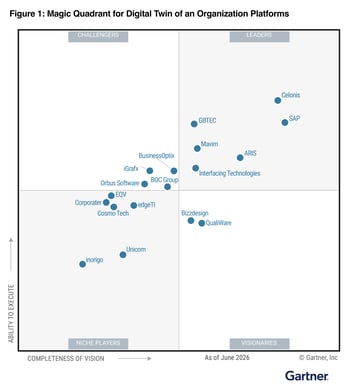
Download your complimentary copy of the report
and see how SAP solutions were evaluated in this category
Do digital twin examples from IoT or manufacturing apply to enterprise architecture?
Monitoring a jet engine, or optimizing a production line use the same underlying concept (a live model of a real system) but apply it to physical assets rather than organizational IT landscapes.
For enterprise architects, the relevant examples are the organizational twin use cases described on this page: cloud migration, M&A integration, compliance management, portfolio rationalization. The principle is the same; the domain is different.
How do you measure the ROI of a digital twin in an EA context?
ROI from the organizational digital twin is typically measured in three areas:
reduction in architecture analysis time (hours saved on manual data collection and model validation per program),
reduction in transformation rework (cost of changes avoided by identifying dependency conflicts in planning rather than in execution), and
reduction in audit preparation effort (time saved on compliance evidence collection).
These are measurable outcomes that can be quantified against a pre-DTO baseline.
Can a small IT team benefit from the organizational digital twin?
Yes. Smaller IT teams often benefit most from the DTO’s automation of data maintenance, because the manual effort of keeping an architecture model current is proportionally larger when the team is small.
The DTO reduces the ongoing maintenance burden by automating data ingestion from connected systems, allowing a small EA team to maintain a current, accurate architecture model without dedicating significant manual effort to it.
What is the first use case to implement when starting with the organizational digital twin?
The most common starting point is application portfolio visibility: connecting the EA tool to the CMDB and cloud infrastructure APIs to populate a current application inventory.
This provides immediate value (a current, accurate application list with ownership and dependencies) and establishes the data foundation for more advanced use cases (simulation, impact analysis, compliance monitoring).
Organizations with an active transformation program often start with the specific use case that program requires: cloud migration analysis, M&A portfolio mapping, or compliance evidence preparation.
Gartner, Inc. Magic Quadrant for Digital Twin of an Organization Platforms. Marc Kerremans, David Sugden, etl. 27 July 2026.
Gartner and Magic Quadrant are trademarks of Gartner, Inc. and/or its affiliates. Gartner does not endorse any company, vendor, product or service depicted in its publications, and does not advise technology users to select only those vendors with the highest ratings or other designation. Gartner publications consist of the opinions of Gartner’s business and technology insights organization and should not be construed as statements of fact. Gartner disclaims all warranties, expressed or implied, with respect to this publication, including any warranties of merchantability or fitness for a particular purpose.