
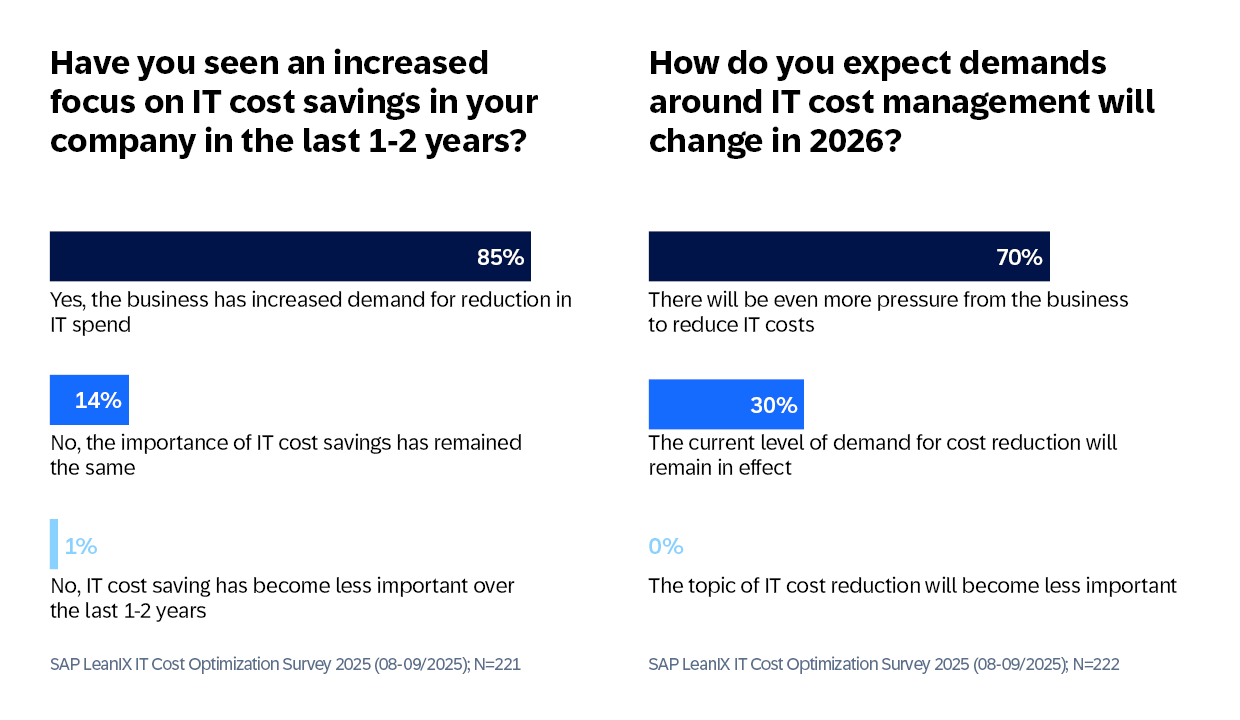
Companies around the world today share a strong and growing focus on IT costs: 85% of those surveyed for the SAP LeanIX IT Cost Optimization Survey 2025 have seen an increased demand for cutting IT costs in the last two years. A large majority (70%) are convinced that this pressure will only continue to increase in 2026. At the same time, it appears these measures are primarily part of enterprise-wide cost-cutting programs, rather than representing a general effort to reallocate budgets.
The following study clearly shows where companies have the highest potential to reduce costs. More than 80% of enterprise architects surveyed estimate that at least 10% to 20% of their annual IT budget consists of avoidable costs, mainly the result of redundant applications and technical debt. It thus comes as no surprise that almost all companies surveyed seek to rationalize their application portfolios. What gets in the way of such measures? According to the majority of respondents it’s a lack of collaboration between IT and business. For example, 80% agree that making decisions about the portfolio is time-consuming and difficult. This is due primarily to lack of clarity around responsibilities, unrealistic time constraints, and a lack of information.
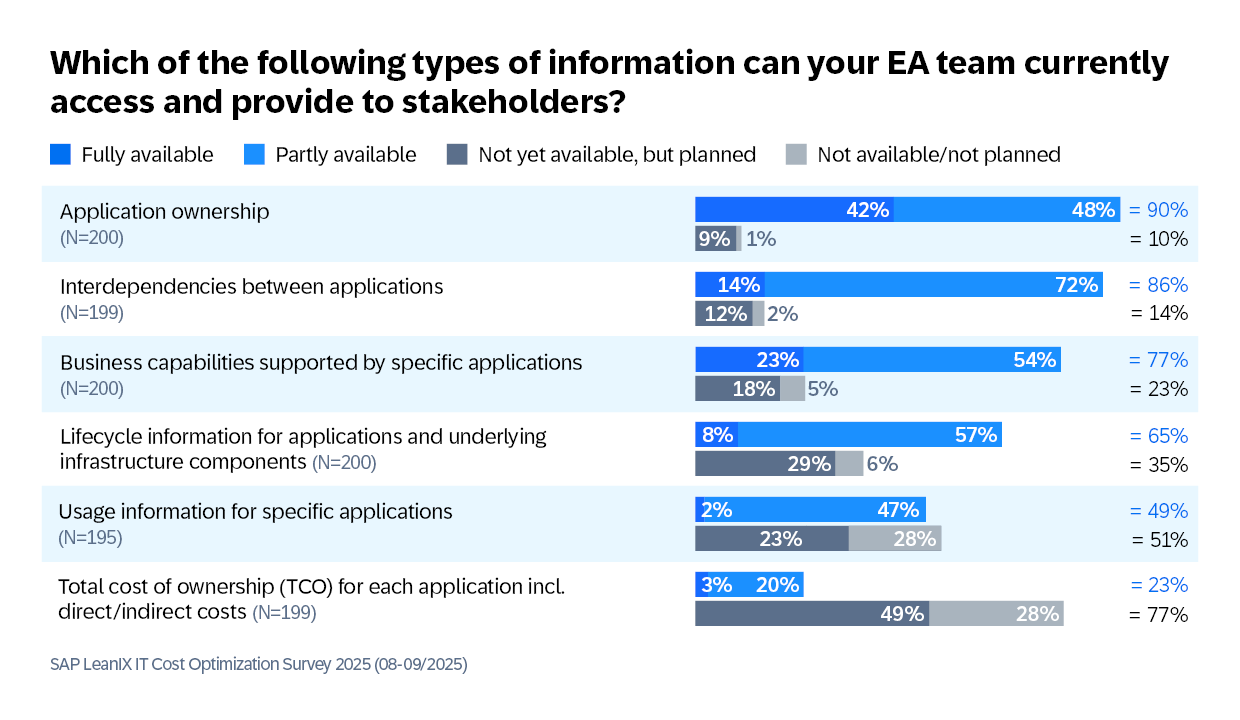
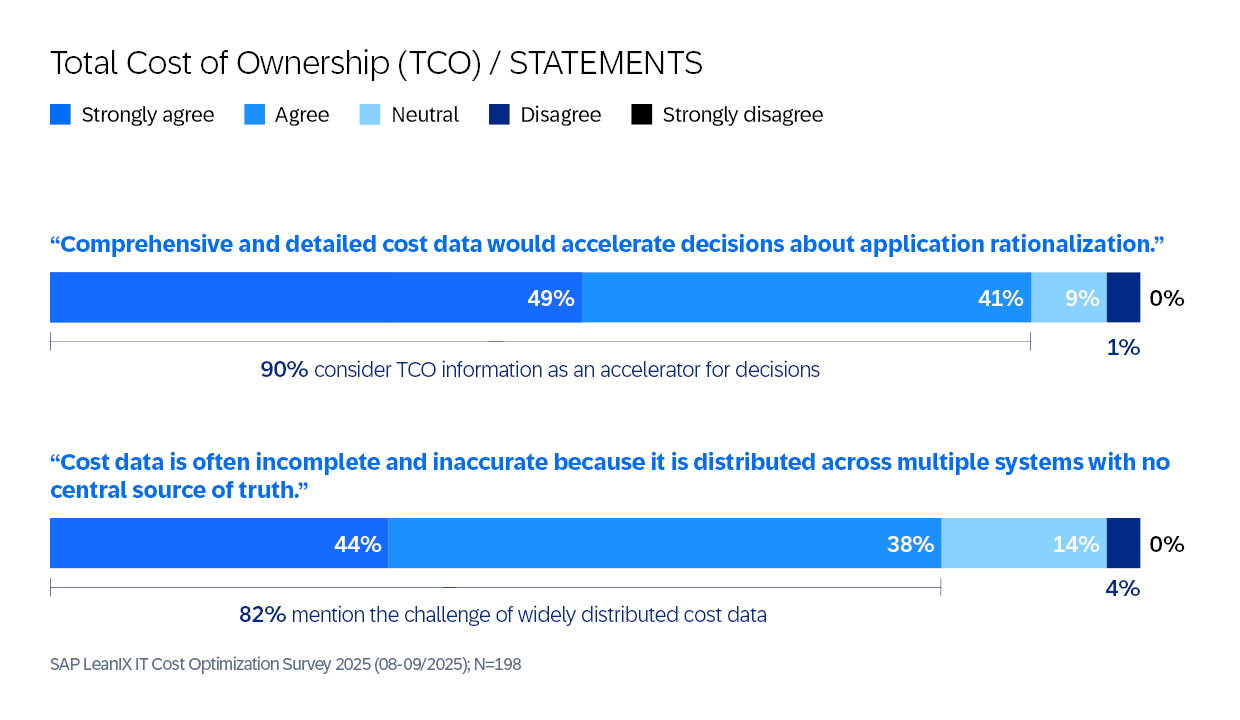
Almost half of the companies surveyed report insufficient data concerning the ownership of applications. In 72% of cases, dependencies between applications are only “partially” documented. Finally, the enterprise architects surveyed have limited access to detailed information related to the total cost of ownership (TCO) of applications. At the same time, 90% of participants in the study agree that such information would accelerate decisions in application rationalization process.
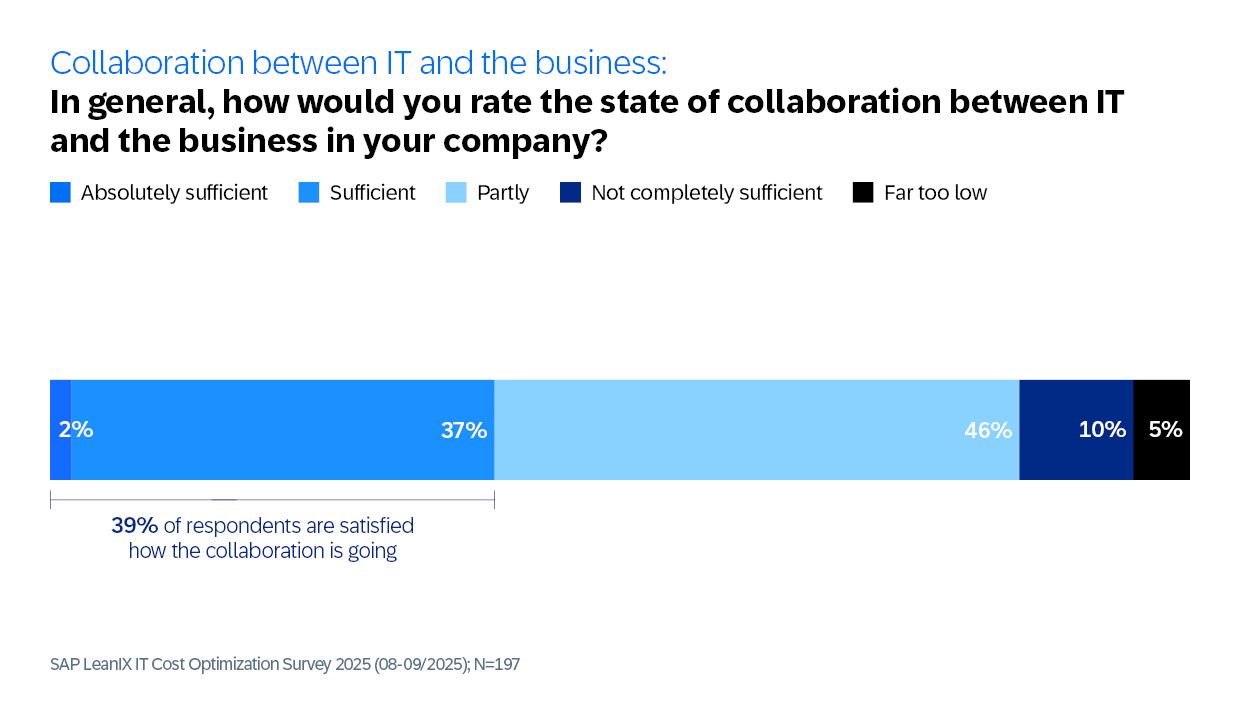
In other words, companies don’t have the data required to enable faster decision-making and the optimization of IT costs. Two-thirds of those surveyed see enterprise architecture (EA) tools as the perfect platform for capturing this cost information for the applications. However, there are doubts as to whether architects should be responsible for collecting and sharing this data, presumably because the data is frequently scattered across numerous systems. Whatever the reasons, these data issues must be addressed. Doing so would undoubtedly improve collaboration between IT and the business, a collaboration which only 39% currently describe as satisfactory.
Against this backdrop, IT leaders also currently face two major challenges. On the one hand, there is the euphoria around the possibilities of generative AI, with IT being expected to identify and act on productive use cases. On the other hand, companies are increasingly financing investment in AI by taking money from existing IT budgets, as SAP LeanIX general manager André Christ pointed out in his keynote at the recent SAP Transformation Excellence Summit. How are companies addressing these cost pressures? What are enterprise architects specifically doing to address them? Which hurdles need to be overcome and where might there be untapped opportunities for cost savings? These and other questions are addressed in this report on the findings of the SAP LeanIX IT Cost Optimization Survey 2025.
An international survey of enterprise architects
Market leaders in enterprise architecture, SAP LeanIX solutions have been used by companies and organizations internationally for many years. The SAP LeanIX IT Cost Optimization Survey 2025, conducted online, was aimed at those responsible for enterprise architecture at 225 companies (all customer accounts) during August and September 2025. Three-quarters of respondents work at companies in Europe, and a further 17% in companies from the United States or Canada. The sample is balanced in terms of company size.
Cost pressure in IT has increased—and will continue to increase
An overwhelming majority (85%) report increased demand for reductions in IT spending over the last two years, and no one surveyed foresees cost saving in IT becoming less important in 2026. On the contrary, 70% of respondents expect the pressure to reduce costs will only increase.
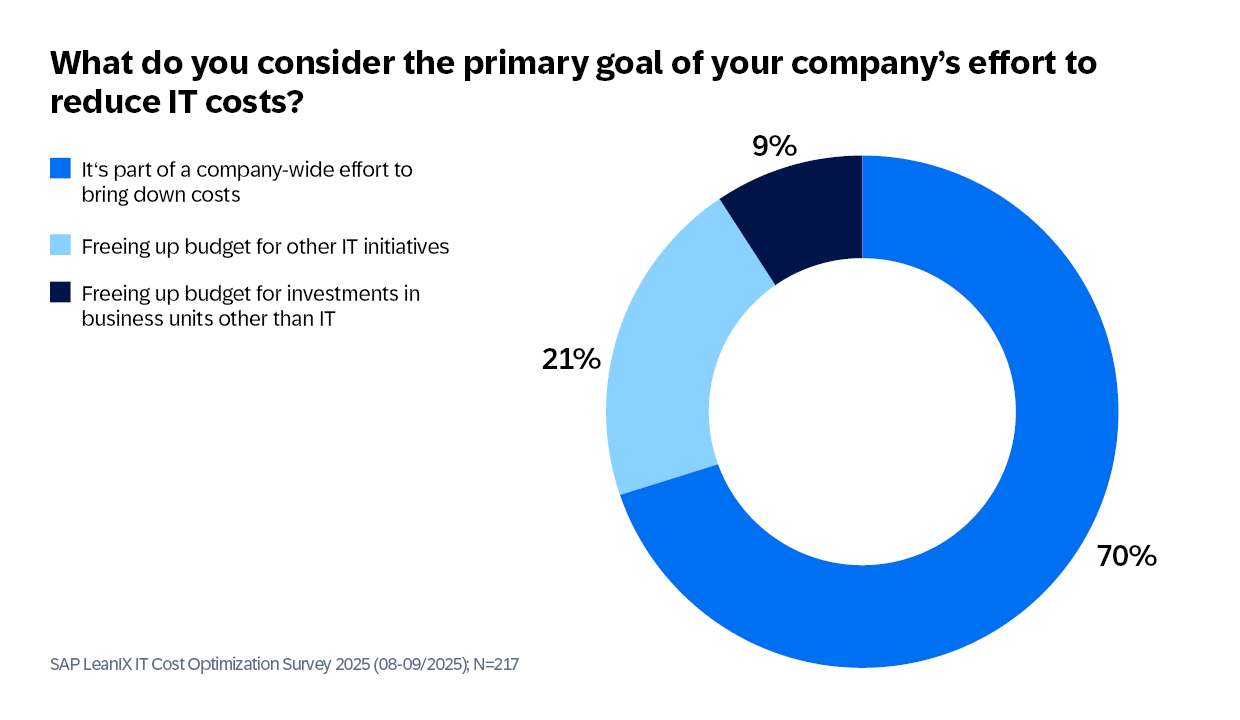
However, it is worth noting what the EA managers surveyed believe to be the primary goal of these IT cost savings: 70% say that these measures are part of an enterprise-wide savings program. Only 21% say they are freeing up budget to invest in other IT projects.
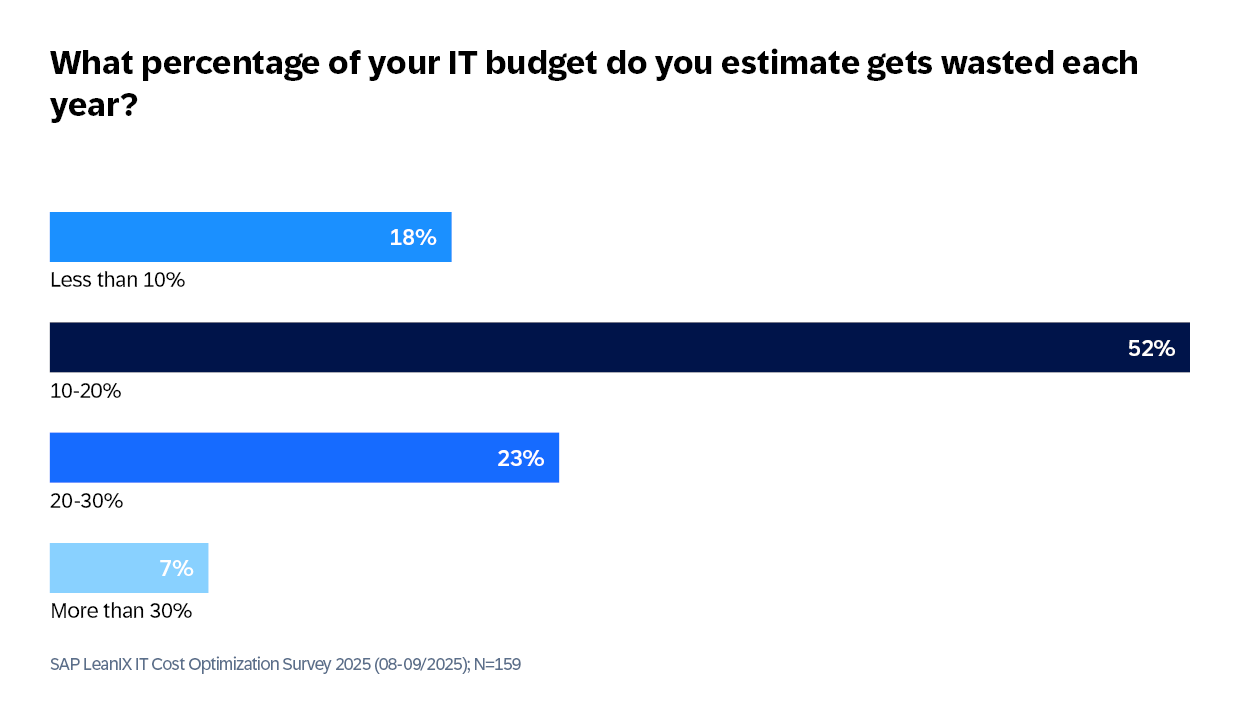
When asked what is behind this avoidable spend, 60% indicate redundant applications and costs generated by technical debt. Overpayment on SaaS licenses is also a major contributor to wasted IT budget, according to just under half of respondents. Finally, a little more than a third of respondents cite unplanned cloud spend as the culprit.
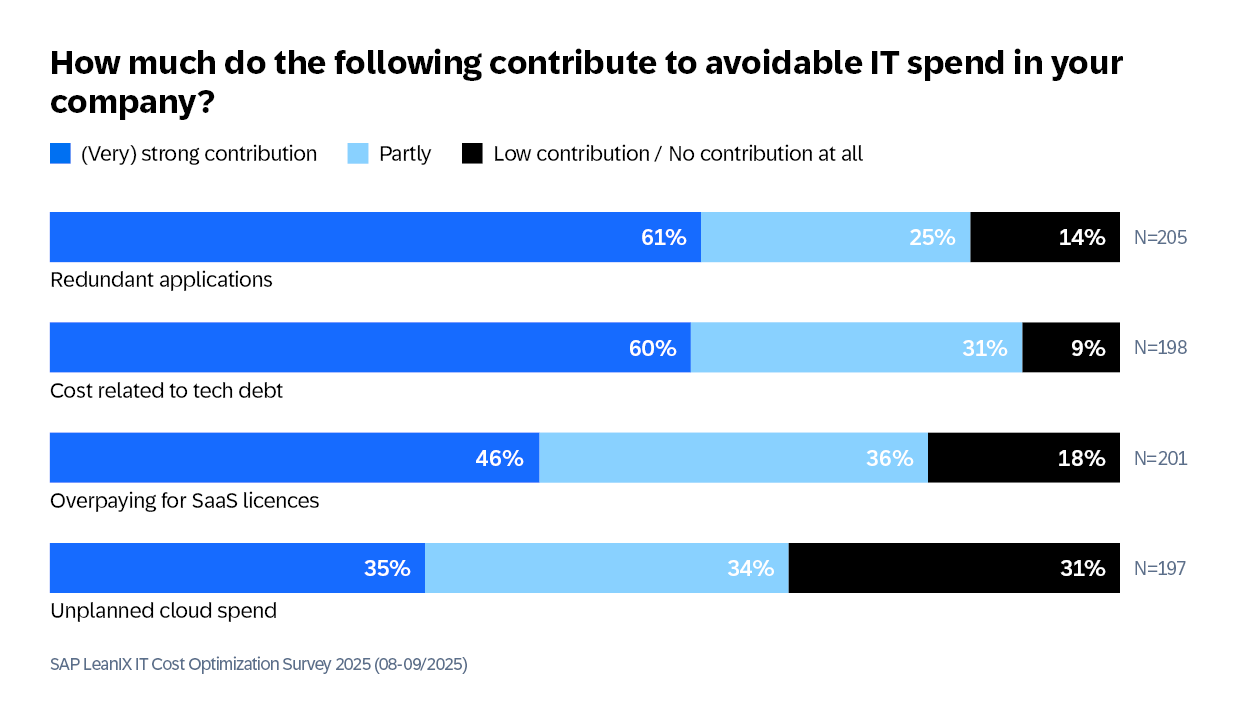
When asked about other drivers of IT spend, respondents repeatedly mentioned one: business units acquiring applications independently and making technology decisions without involving IT. This practice, often referred to as shadow IT, is, in the opinion of many respondents, responsible for a large portion of avoidable costs. This problem—the presence in the organization of applications that are unknown to IT—may also be the reason why more than a quarter of those surveyed (28%) feel unable to estimate how much of the IT budget is wasted.
Application rationalization is on the agenda almost everywhere
More than half of the companies surveyed regularly implement or have already implemented measures to analyze and optimize the application portfolio. A further 40% are currently planning such a program. This means that application rationalization is on the agenda of almost every company. Given the cost pressure on IT mentioned above and the relatively high percentage of avoidable IT costs, this is hardly surprising.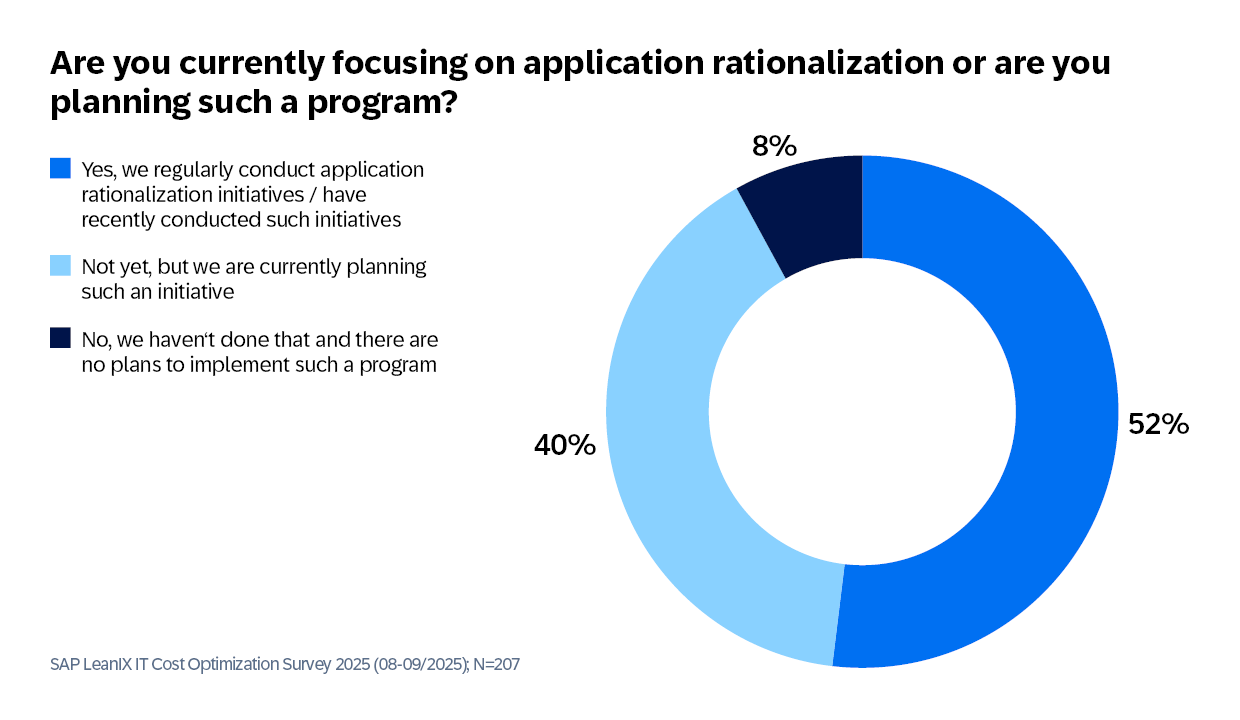
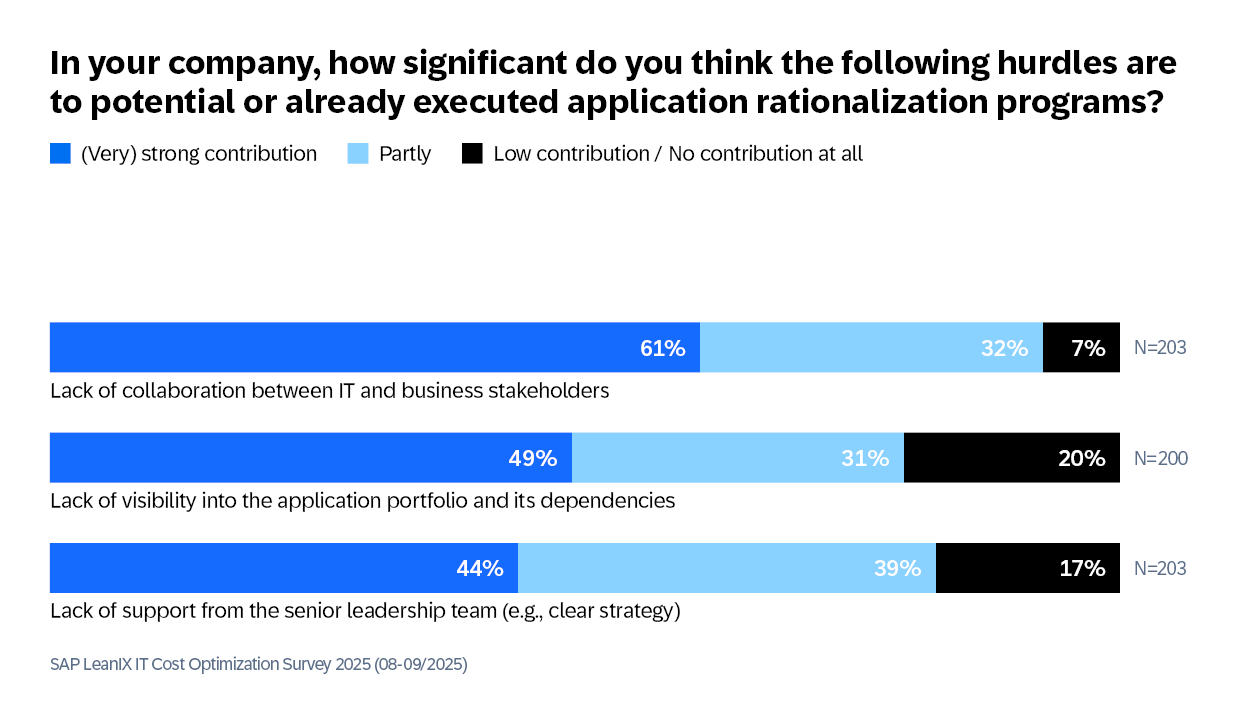
But there are hurdles on the way to a streamlined portfolio: 61% of those surveyed identify lack of collaboration between IT and business stakeholders as their biggest challenge, while only 7% see it as no problem. Nearly half of respondents complain about the lack of transparency regarding the application portfolio and its interdependencies, while 44% state that lack of support from the senior leadership team makes the rationalization process more difficult.
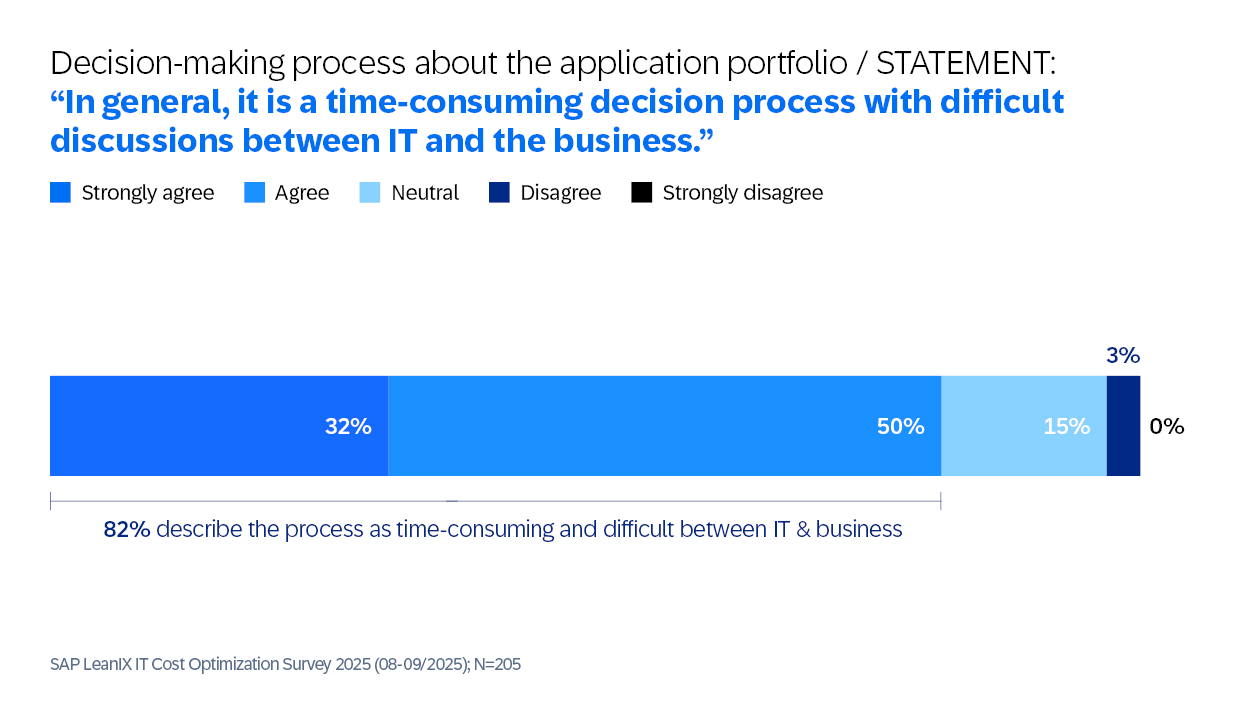
What gets in the way of a smooth decision-making process? Half of the EA managers surveyed put unclear roles and responsibilities, including scattered budget responsibilities, at or near the top of the list. Unrealistic corporate timelines are named by 40% as the biggest problem when it comes to making informed decisions. The same number indicate that the biggest challenge is the lack of relevant information on the applications under discussion. A similarly high proportion of respondents (36%) point to complaints that the decision-making criteria do not reflect business needs. A lack of a standardized process is likewise seen by 34% as a major challenge, although this issue was ranked in last place by the most respondents.
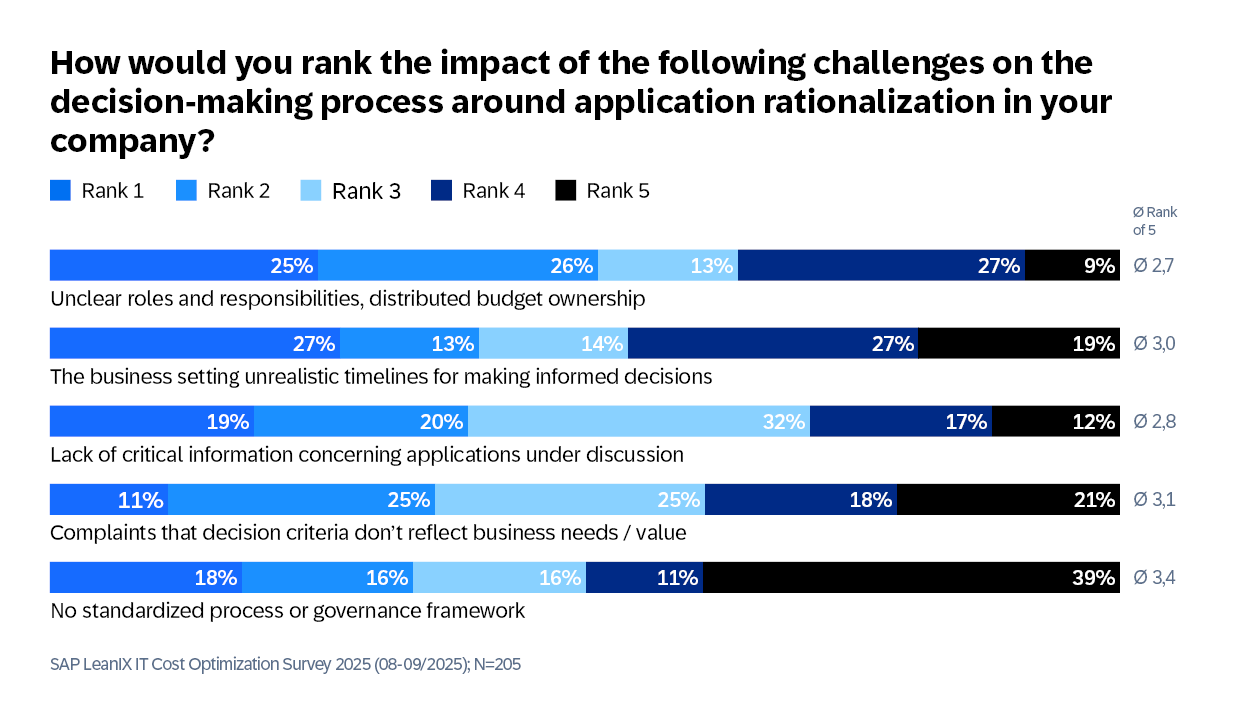
It is obvious that there is no one problem that everyone is struggling with, as respondents rank the challenges differently. Nevertheless, the challenges fall into two basic categories. On the one hand are organizational issues around collaboration, roles, and timelines. On the other are issues around data and visibility.
As the stewards of the application portfolio, enterprise architects generally collect and manage the data used to analyze and optimize this and other technology investments. The question therefore arises as to which data the surveyed EA managers have today—and where there are critical gaps.
A great deal of information on applications is incomplete
Over 40% of companies have complete data on the ownership of applications, and 23% have complete information on which business capabilities are supported by specific applications.
It’s worth pointing out that for all the information asked about in this survey, the majority of respondents concede that it is only “partially” available, if at all. For example, only half of those surveyed currently have (in some cases only partial) usage data for specific applications. Data on the TCO of applications is even more rare: in 77% of cases, EA managers surveyed currently have no access to this data, though most are planning to make it available in the future.
Detailed cost data would accelerate decisions
The fact that so many EA managers surveyed say they are interested in TCO data for their applications can be explained easily: 90% believe that it would speed up the application rationalization process. Unfortunately, almost as many respondents (82%) believe that cost information is often incomplete and incorrect because it is distributed across different systems and not captured in a central data source.
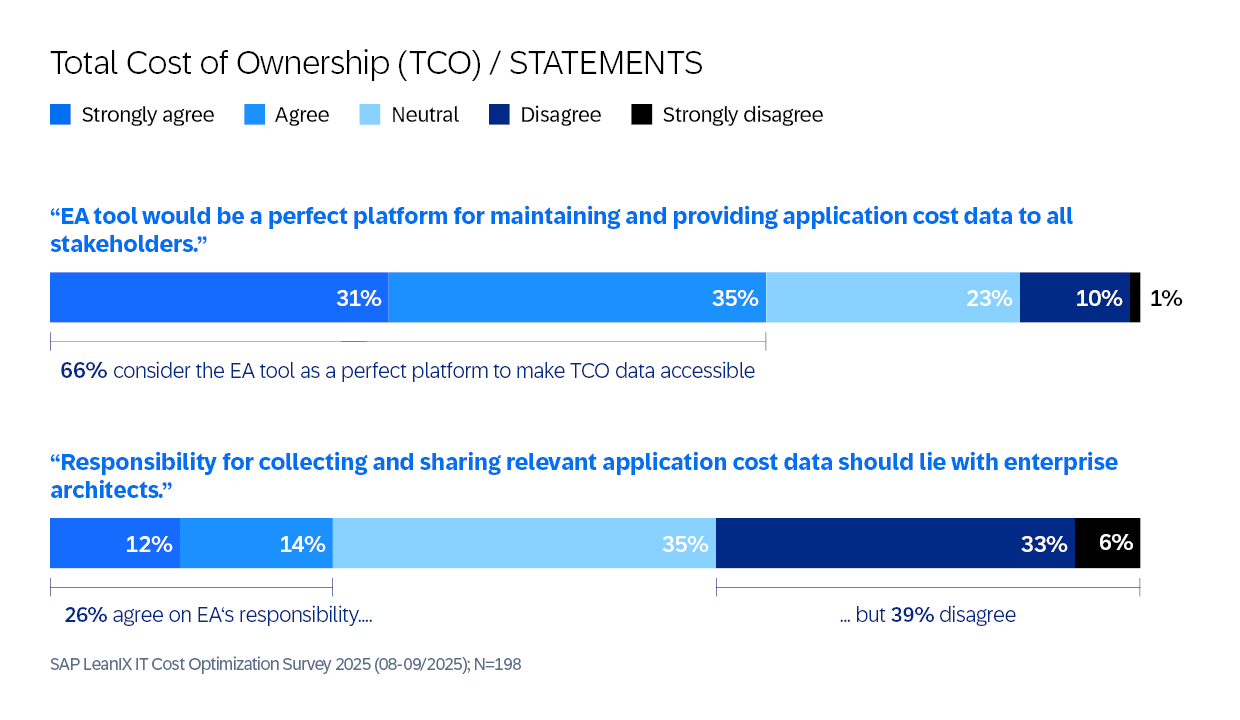
EA tools could become such a central source: Two-thirds of respondents see these tools as an appropriate platform for capturing detailed cost information and making all relevant application portfolio data available in one place. However, only 26% agree that the responsibility for gathering and maintaining the data should lie with enterprise architects. This is not surprising, since this information is often widely scattered across the organization, making collection and data management an interdepartmental challenge.
General collaboration between IT and business could be better
Finally, 39% of EA managers are generally satisfied with the collaboration between IT and the business, seeing it as sufficient. Given the degree to which overcoming cost optimization challenges depends on collaboration between these two stakeholders, it is alarming that fewer than half of the respondents see this collaboration in a positive light.
Conclusion: It's not about whether IT costs are optimized, but how this is done
One thing is clear: survey respondents have seen increased pressure to cut IT costs and believe this pressure will continue into the future. The good news is that most respondents also recognize significant, avoidable spend in their IT budgets. In fact, since the last Cost Optimization Survey, the percentage of respondents saying that avoidable spend is greater than 20% of the budget has grown from 23% to 30%. There is also a widespread belief that most of this waste arises from combination of redundant applications and technical debt.
There is also a widespread belief that most of this waste arises from combination of redundant applications and technical debt.
Finally, if we look across the organizations surveyed, the number either pursuing application rationalization or planning on doing so suggest a common agreement that this is the best way to address the situation and reduce IT spend.
As good as that sounds in theory, the reality is that IT and business leaders encounter common hurdles on the path to effective application rationalization.
As mentioned above, the hurdles are both organizational and operational. On the organizational front, the SAP LeanIX IT Cost Optimization Survey 2025 reveals a general dissatisfaction with regard to collaboration between IT and business (although satisfaction has inched up slightly since 2023). The fact that decisions about the application portfolio are seen as time-consuming and difficult reflects this dissatisfaction. What’s more, we see the business questioning the decision-making criteria in these discussions, while IT leaders believe unrealistic time constraints (set by the business) prevent them making truly informed decisions.
On the operational side, we find a pervasive lack of data and visibility. While levels of access to the relevant data can vary for decision-makers—data on application ownership is easier to come by than data on application lifecycles or usage—even in the best cases the data available can often be incomplete.
More important from a cost-optimization standpoint is the fact that TCO data is the hardest of all to come by. What makes this particularly unfortunate is that almost all respondents believe this information would accelerate decisions about the portfolio. Indeed, the majority of respondents also agree that their EA solution would be ideal for aggregating this data—which tends to be distributed across multiple solutions—in one central location.
The added benefit of bringing all relevant data, from ownership to total costs, together in one solution is that it can improve the collaboration between IT and the business. A single, comprehensive source of truth covering the application landscape not only fosters alignment based on a shared view of the business but also unlocks value faster by accelerating the decision-making process.
SAP LeanIX IT Cost Optimization Survey 2025: Further information about the study
In August and September 2025, SAP conducted an online survey of 225 enterprise architects and IT managers from its global customers regarding the potential to optimize IT costs and other related topics. In terms of company size, the sample is balanced. Nearly three-quarters of respondents come from companies in Europe, and a further 17% are from the United States and Canada.
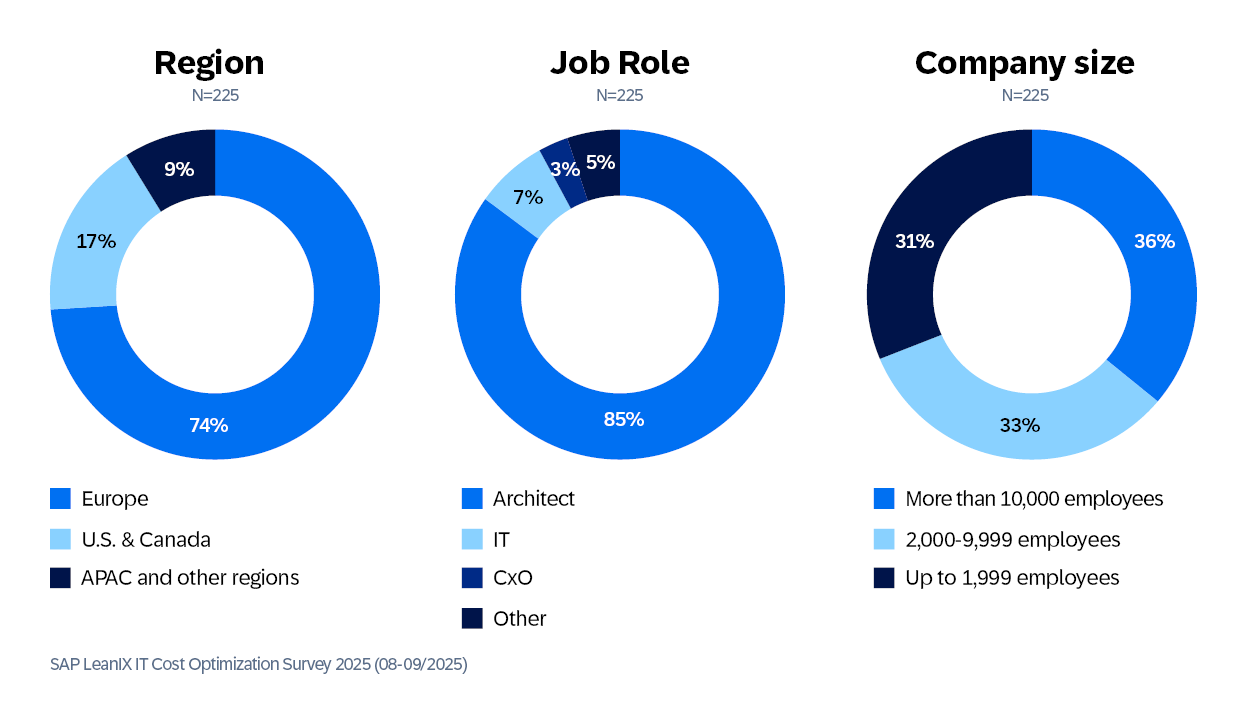
Differences in the number of respondents represented in the charts result from the exclusion of respondents who could not or would not provide information on individual topics. For better readability, the results in this report are presented as percentage values without decimal places.

/EN/White-Paper/EN-IDC-Inforbrief-Application-Rationalization-Portfolio-Management-Thumbnail_v2.png?width=260&height=171&name=EN-IDC-Inforbrief-Application-Rationalization-Portfolio-Management-Thumbnail_v2.png)