Elevate your Enterprise Architecture with Artificial Intelligence
Learn moreSAP LeanIX Customers
A growing list of industry leaders and organizations of all sizes who trust in SAP LeanIX
See Full ListMaximize market potential through a partner program offering LeanIX solutions tailored to your business model.
Learn moreTake your capabilities to the next level and arm yourself with the knowledge you need
See all resourcesAI-native enterprise architecture is an evolution of traditional EA practice in which AI governs the organization's AI estate and AI tools automate the maintenance, enrichment, and analysis of the EA repository.
AI-native enterprise architecture extends traditional enterprise architecture practice in two directions: using AI to automate the data maintenance work that limits EA at scale, and extending EA governance to cover the AI agents now operating across the business.
AI-native enterprise architecture is an evolved model of EA practice where artificial intelligence is embedded in both directions: the EA function governs AI adoption across the organization, and AI tools augment or automate the work of enterprise architects.
Classic EA is a documentation and governance discipline. Enterprise architects maintain a repository of applications, capabilities, and relationships; they analyze the landscape for risk, redundancy, and strategic alignment; they produce the views and recommendations that guide technology investment. The quality of that analysis depends on the quality of the underlying data, and that data has traditionally been maintained by a small team through manual effort.
AI-native EA changes the maintenance model. AI agents can discover, enrich, and validate EA data continuously. Automated discovery surfaces applications that haven't been manually registered. AI assistants convert existing documentation (architecture diagrams, spreadsheets, assessment reports) into structured fact sheets. Data quality becomes a continuous process sustained partly by agents, not a periodic project managed entirely by people.
At the same time, the scope of what EA must govern has expanded. Every organization deploying AI agents needs those agents documented, governed, and integrated into the same architectural framework as the rest of the IT estate. Agents have dependencies, access rights, data sources, and lifecycle considerations that mirror the governance requirements applied to traditional applications.
AI-native EA is the response to both pressures: using AI to scale EA practice, and extending EA practice to govern AI.
The distinction is not about features: it is about how the EA function sustains itself and what it governs.
| Dimension | Traditional EA | AI-native EA |
| Data maintenance | Manual; EA team updates records periodically | Continuous; AI agents enrich and validate data as part of normal operations |
| Discovery | Inventory built and refreshed manually | Automated discovery across SaaS, self-built software, and AI agents |
| Scope | Applications, capabilities, and infrastructure | Applications, capabilities, infrastructure, and AI agents |
| Architect role | Data collection, analysis, and governance | Analysis and governance; AI handles much of the data layer |
| Decision support | Static views and reports produced by the EA team | AI-assisted analysis surfaces insights and recommendations on demand |
| Data quality posture | Periodic campaigns to clean and enrich | Ongoing; quality improves as a byproduct of normal EA operations |
The central shift is in how data quality is sustained. Traditional EA practice depends on human effort to keep the repository current. AI-native EA distributes that work partly to application owners through structured collection workflows, and partly to AI agents through automated discovery and enrichment. The EA team's role shifts from data custodian to governance architect.
Success Kit
Everything you need for quick time-to-value and long-term success through EA.
AI-native EA operates across two dimensions that reinforce each other: governing AI agents within the enterprise architecture framework, and using AI to automate the data maintenance work that sustains EA practice at scale. These are not sequential stages but parallel developments — organizations typically begin addressing both as they extend their EA practice into the AI era.
As organizations deploy AI agents, those agents become part of the IT landscape. They have dependencies, access rights, data sources, and lifecycle considerations, the same governance requirements that apply to any other application. Enterprise architecture is the natural home for AI agent governance because EA already manages the applications, data sources, and APIs that agents need to access.
AI-native EA extends the existing EA framework to capture:
Agent inventory: what AI agents are deployed, approved, and in development
Agent capabilities: what each agent does, what data it accesses, what systems it interacts with
Agent dependencies: how agents connect to applications, APIs, and data sources in the broader IT landscape
Compliance posture: which agents handle regulated data, what access controls are in place, and what the governance approval trail looks like
The gap in most organizations is not intent but visibility. The SAP LeanIX Agentic AI Survey 2026 found that 90% of companies view AI visibility as strategically important, but only 14% report actually having it. Closing that gap requires the same structured approach that EA applies to the rest of the portfolio.
The second dimension runs in the opposite direction. AI tools reduce the manual overhead of EA practice, making it possible for small EA teams to govern larger, more complex landscapes than would otherwise be tractable.
AI augments EA work in four ways:
Automated discovery: surfaces SaaS applications, self-built software, and AI agents that haven't been manually registered, closing the visibility gaps that manual tracking produces
AI-assisted enrichment: converts existing documentation into structured EA data, and generates draft descriptions, relationships, and recommendations for architect review
Architecture guidance: continuously analyzes the inventory and surfaces actionable insights, identifying risks, flagging gaps, and guiding architects through the next steps without requiring a manual analysis cycle
Decision support: surfaces relevant data, flags conflicts between current state and proposed changes, and enables on-demand architectural analysis rather than periodic reporting
These two dimensions reinforce each other. Organizations that use AI to automate EA work build a more complete and current repository. A more complete repository makes it possible to govern AI agents effectively. Better AI governance creates ongoing demand for the enrichment that AI tools provide.
The practical outcomes of an AI-native EA practice differ from traditional EA in three areas.
Faster decision support. When data quality is maintained continuously and AI tools can surface relevant records on demand, architectural analysis that previously required days of manual data preparation becomes available in hours. The EA function moves from producing periodic reports to providing on-demand decision support.
Governance at scale. Traditional EA practice has a practical ceiling set by the size of the team. AI-native EA raises that ceiling by distributing data maintenance to application owners and AI agents. EA teams that can realistically govern a few hundred applications manually can govern thousands when the data layer is automated.
Integrated AI governance. Organizations that govern AI agents through EA don't need separate AI governance frameworks. The same portfolio views that show application risk, lifecycle status, and dependency relationships can show the same dimensions for AI agents, making AI governance an extension of existing practice rather than a separate discipline requiring separate tooling.
The transition to AI-native EA follows the same maturity progression that EA adoption has always followed, beginning with structure and data quality, and adding AI augmentation progressively.
The practical starting point is a well-governed EA repository: a defined data model, named ownership for application records, and completeness standards enforced through regular review. Without that foundation, AI enrichment has nothing reliable to build on.
Once the repository baseline is in place, AI-native practices can be introduced in sequence:
Automated discovery as a first layer, surfacing what isn't already in the repository without requiring manual collection
AI-assisted enrichment, converting existing documentation and completing incomplete records progressively
Agent governance, extending the existing EA framework to capture AI agents as a new object type alongside applications and capabilities
AI-assisted decision support, using the enriched repository to power real-time architectural analysis and planning
The organizations that move fastest are not the ones that start with the most complete data. They are the ones that establish governance structures early and use AI tools to close the gaps progressively. Each layer builds on the one before it: automated discovery improves coverage, better coverage improves enrichment quality, and better enrichment improves the analytical outputs the EA function delivers.
SAP LeanIX is built to support both dimensions of AI-native EA across three capability layers.
The Agentic AI layer, anchored by the EA Assistant, handles conversational and task-completing work: querying the repository, comparing and updating fact sheets, and running multi-step data quality tasks.
The Generative AI layer embeds AI directly into everyday workflows: Embedded AI generates descriptions and enriches incomplete records; Architecture Guidance continuously analyzes the inventory and surfaces actionable next steps; Joule lets any user navigate the full IT landscape in natural language without needing to understand the product interface.
The MCP server for EA connects external AI tools and custom agents to the repository through a secure, standardized gateway, enabling external LLMs and agentic platforms to read and write EA data without custom integrations. The AI Agent Hub extends the existing EA framework to cover AI agents as a governed object type alongside traditional applications.
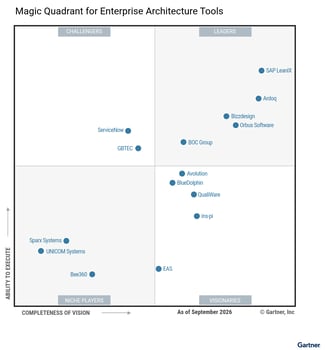
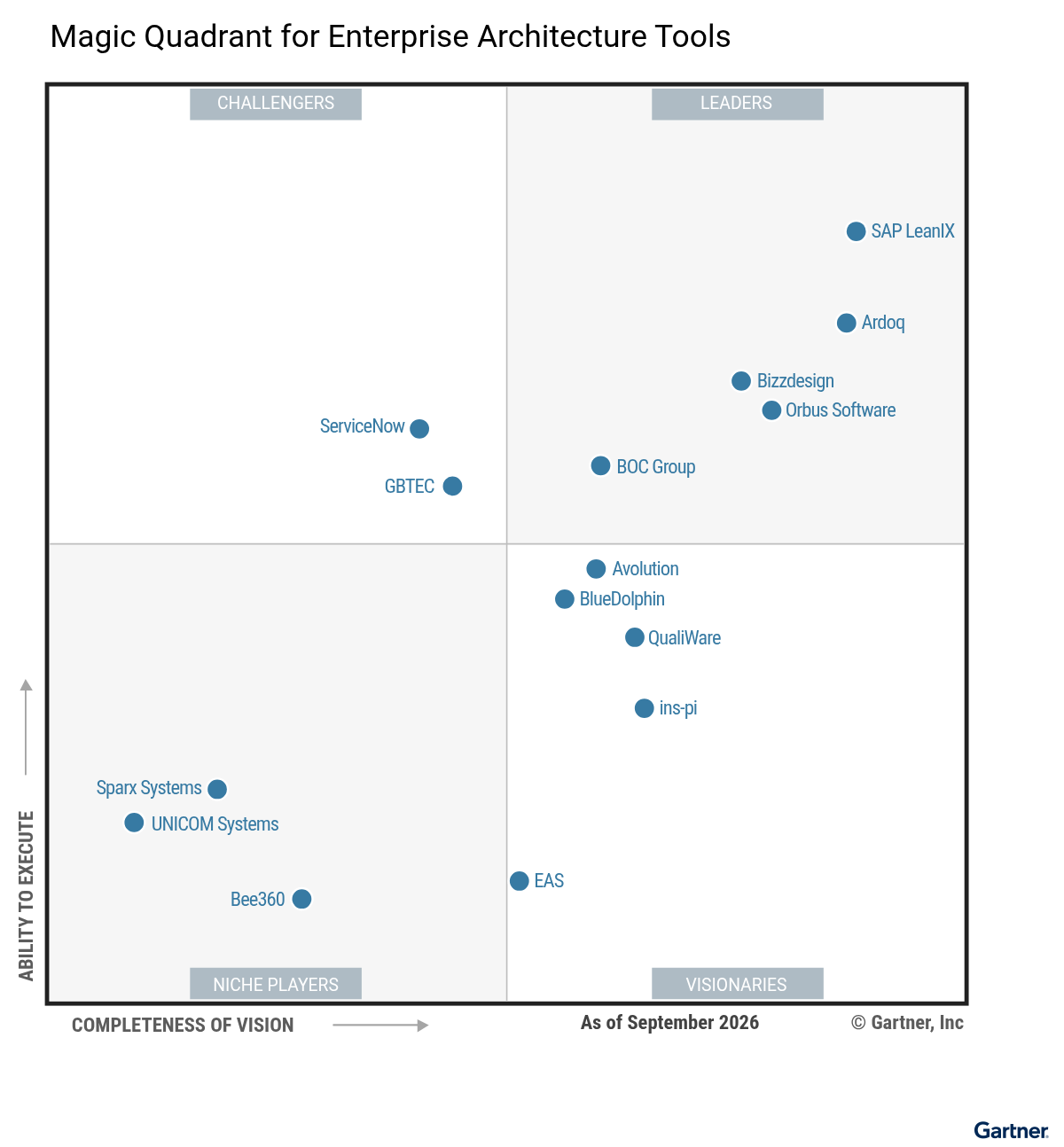
Learn why Gartner recognized SAP LeanIX as a Leader in EA Tools for the sixth consecutive year.
Is AI-native EA just adding AI features to an existing EA tool?
What is the difference between AI-assisted and AI-native EA?
Does AI-native EA require replacing existing EA tools?
Does AI-native EA eliminate the need for human governance?
Gartner, Magic Quadrant for Enterprise Architecture Tools, By Austin Steinmetz, Rowan Wakeford, Rhyan Light, 13 October 2026
Gartner does not endorse any company, vendor, product or service depicted in its publications, and does not advise technology users to select only those vendors with the highest ratings or other designation. Gartner publications consist of the opinions of Gartner’s business and technology insights organization and should not be construed as statements of fact. Gartner disclaims all warranties, expressed or implied, with respect to this publication, including any warranties of merchantability or fitness for a particular purpose.
Gartner and Magic Quadrant are trademarks of Gartner, Inc., and/or its affiliates.
This graphic was published by Gartner, Inc. as part of a larger research document and should be evaluated in the context of the entire document. The Gartner document is available upon request from SAP LeanIX.