Elevate your Enterprise Architecture with Artificial Intelligence
Learn moreSAP LeanIX Customers
A growing list of industry leaders and organizations of all sizes who trust in SAP LeanIX
See Full ListMaximize market potential through a partner program offering LeanIX solutions tailored to your business model.
Learn moreTake your capabilities to the next level and arm yourself with the knowledge you need
See all resources
Enterprise architecture data quality is defined as the accuracy, completeness, and currency of the information held in an EA repository and the processes that maintain that information over time.
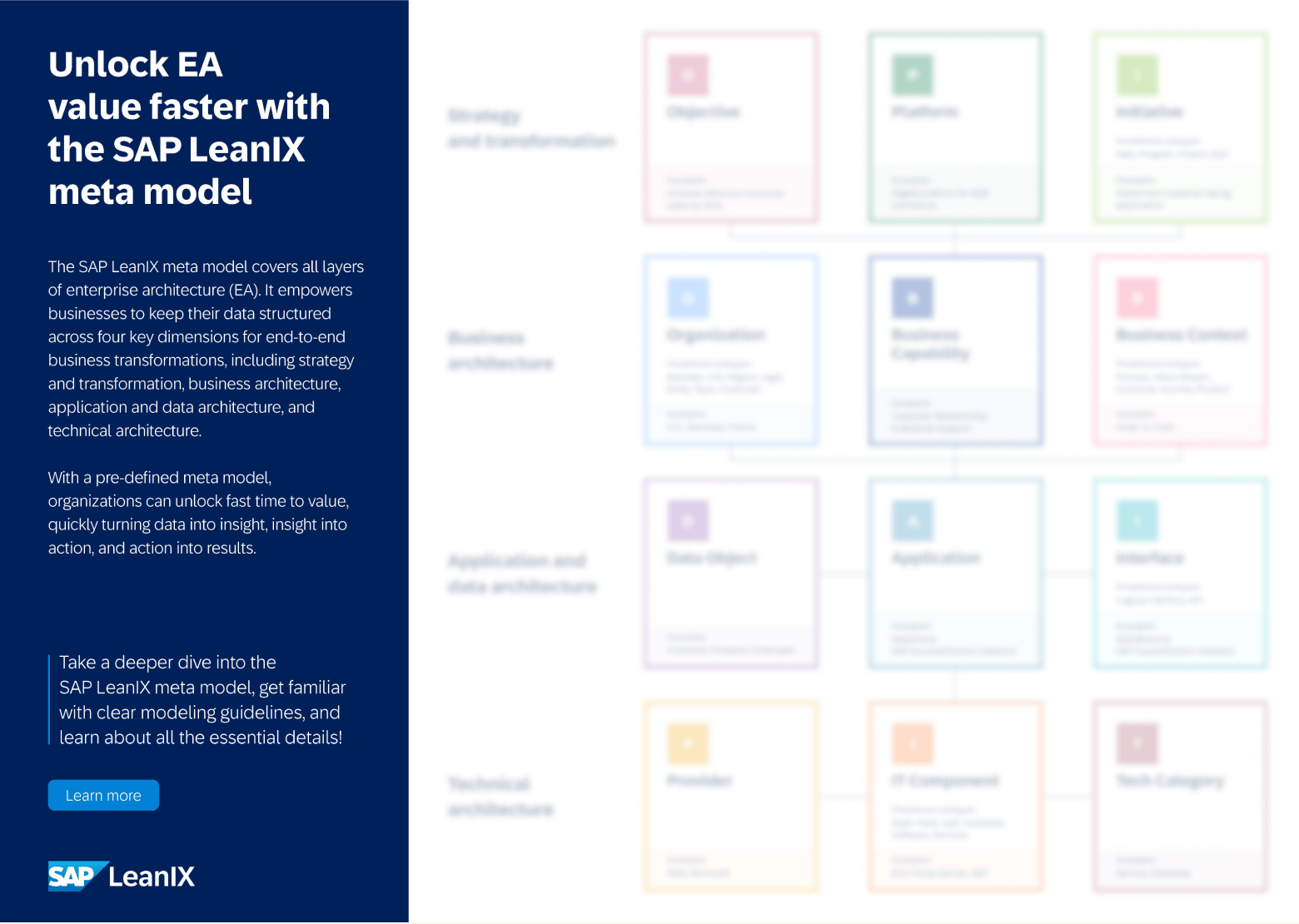
► Discover how you can utilize the pre-defined Meta Model from LeanIX
An EA repository is only as useful as the data it holds. The framework choices, the diagram types, the governance views produced for CIOs and program managers all rests on a single underlying condition: that the records are accurate and current.
When that condition holds, the model supports reliable decisions. When it doesn't, the model still looks authoritative. That gap between apparent and actual accuracy is where the governance risk sits.
Architecture data doesn't degrade randomly. It degrades in predictable patterns, for predictable reasons.
The most common cause is centralized data maintenance in a distributed environment. Architecture data is typically maintained by a small EA team (sometimes two or three people) while the information that matters most about each application is held by dozens of application owners, business stakeholders, and IT system administrators distributed across the organization.
The EA team cannot know the business criticality, interface changes, lifecycle decisions, and usage patterns of every application without continuous input from the people responsible for them. That input rarely arrives unprompted, which means the repository gradually reflects the state of the organization as it was when the last round of data collection took place.
The second pattern is the snapshot problem: organizations relying on manual data collection (periodic surveys sent by email, interviews, spreadsheet updates) capture a point-in-time view that begins to stale the moment it is recorded.
In EA specifically, the cost shows up in architecture decisions made on outdated information, transformation programs that surface surprises mid-execution, and technology risk assessments that miss end-of-life applications because lifecycle status has not been updated.
The third pattern is abandonment under load. When maintaining a fact sheet requires coordinating with the EA team, submitting change requests, or navigating a tool that requires architectural expertise, application owners disengage. The repository diverges from reality, and as reliability drops, so does adoption, which accelerates the divergence.
As guidance within TOGAF emphasizes, architecture repositories that are not continuously maintained lose stakeholder trust and governance value quickly.
Organizations with immature or fragmented EA practices face a particular challenge: the perception that an EA tool cannot deliver value until the data is already in good shape. This creates a barrier to entry that affects the organizations that need the tool most.
The cold start problem is partly a data problem and partly a framing problem. It is a data problem because initial population takes effort: applications need to be identified, ownership assigned, relationships documented. It is a framing problem because the value threshold for an EA repository is lower than most teams assume.
A portfolio with 70% of applications cataloged with basic attributes provides real governance value: lifecycle analysis, redundancy identification, risk exposure, application rationalization decisions. The goal is not 100% completeness before operating; it is a trusted enough baseline to govern from, with completeness improving continuously.
The tool choices that address the cold start problem are specific: automated discovery that populates the initial inventory without manual data entry, AI-assisted migration that converts existing documentation into structured records, and clear incremental coverage tracking that shows governance value at each stage of completeness rather than only at the end.
The most durable approach to EA data quality is distributed ownership: assigning data maintenance responsibility to the people who hold the information, not centralizing it in the EA team.
In practice, this means each application owner is responsible for maintaining the attributes they know best (business criticality, functional fit, lifecycle status, contact details, key interfaces) while the EA team owns the governance layer: the relationships between entities, the architecture decisions, the completeness standards, and the views consumed by CIOs and business stakeholders.
This model only works if contributors are engaged and guided. The mechanisms that make it operational in an EA platform are structured data collection requests sent to named application owners, visible completeness indicators on each record, and automated maintenance reminders triggered by defined conditions (lifecycle review dates, detected changes in dependent systems). Together, these shift the EA team's role from data collector to data governance owner.
The architecture review board plays a structural role in distributed ownership: it brings together cross-organizational representatives who both consume and contribute to the portfolio data, creating an accountability loop that extends beyond the EA team.
Distributed ownership addresses human-generated data. Automated discovery addresses the larger problem of applications that no one actively reports: shadow IT, unmanaged SaaS subscriptions, and ERP (SAP) systems that accumulate outside formal documentation.
EA repositories maintained by manual data collection consistently underestimate the real size of the IT estate. Application portfolio management consistently surfaces applications that IT teams were not aware of, a gap that manual inventory processes cannot close because discovery depends on people reporting what they are aware of.
Discovery integrations identify applications across cloud, SaaS, and enterprise software environments without requiring manual documentation from each team. Integrations with CMDBs, ITSM tools, and cloud infrastructure platforms keep the repository synchronized with operational data sources continuously, so the inventory stays current between review cycles rather than only at the point of last manual update.

The most time-consuming parts of initial data population (enriching unstructured documentation, researching application details, migrating content from legacy tools) are also the most suitable for automation.
EA platforms are incorporating AI capabilities that reduce the manual effort at these stages. The pattern emerging across leading tools is a layer that converts existing architecture documents, diagrams, and content into structured repository entries, accelerating the transition from legacy documentation to a live repository without manual re-keying. This addresses the cold start problem directly: the initial population effort that has historically been a barrier to early governance value is reduced by AI-assisted ingestion.
Some platforms also expose repository data to external AI tooling through API-accessible interfaces, allowing AI agents to read from and write to the portfolio directly rather than through periodic human review.
Data quality in an EA repository is measurable, and managing it requires treating completeness as an ongoing metric rather than a project milestone.
The dimensions of EA data quality that matter in practice:
Coverage: what percentage of applications in scope have been cataloged at all
Attribute completeness: for cataloged applications, what percentage of defined required attributes are populated
Freshness: when was each record last reviewed or updated, and does that meet the governance standard
Relationship completeness: how thoroughly are applications connected to business capabilities, IT components, interfaces, and lifecycle decisions
EA platforms track these dimensions through configurable completeness standards, with the governance team defining which attributes must be populated for a record to meet the required threshold. Enterprise architecture metrics covers how EA programs measure portfolio health more broadly.
The most effective approach to progressive improvement is setting incremental coverage targets rather than aiming for full completeness before operating. A portfolio with 80% critical-application coverage and accurate lifecycle status provides real governance value: application rationalization analysis, risk identification, transformation planning.
The governance value compounds as coverage improves; organizations do not have to wait for 100% completeness to act on what the data shows.
SAP LeanIX's enterprise architecture tool supports the approaches described above through three capability areas.
The unlimited collaborative user model gives every application owner direct access to their own Fact Sheets, removing the EA team as intermediary for updates.
Surveys send structured data collection requests to named owners at defined intervals, presenting specific fields with context rather than open-ended email requests.
Quality Seals surface a live completeness signal on each Fact Sheet: when required attributes are missing or review dates have passed, the responsible owner is notified automatically.
Automations trigger maintenance requests based on defined conditions (lifecycle review dates, dependency changes, newly detected applications). The result is data quality maintained as a continuous background process rather than a periodic project.
SaaS discovery detects applications in use across the organization by analyzing identity provider logs and network data, surfacing shadow IT and unmanaged subscriptions that manual inventories miss.
ERP (SAP) discovery identifies SAP systems, services, and custom-built extensions without requiring the SAP team to document each component manually.
Out-of-the-box integrations with CMDBs, ITSM tools, and cloud infrastructure platforms keep the SAP LeanIX repository synchronized with operational data sources continuously, so the inventory stays current between review cycles, not only at the point of last manual update.
AI capabilites of SAP LeanIX, such as the EA Assistant automates data enrichment tasks that would otherwise require manual input.
The EA content agent converts existing architecture documents, Visio diagrams, and unstructured content into structured Fact Sheet entries, directly reducing the initial population effort that has historically been the main barrier to early governance value.
The MCP server enables AI tooling to read from and write to the SAP LeanIX repository directly, so AI agents can engage with portfolio data without waiting on periodic human review.
"The collaborative features are incredibly valuable. They allow teams to update and maintain application data together, ensuring that information remains current and supports consistent decision-making across departments." - 4.5★, Enterprise - G2
Quickly turn data into insight and insight into tangible results!
See the full picture across Strategy & Transformation
See the full picture across Business Architecture
See the full picture across Application & Data Architecture
See the full picture across Technical Architecture
Does EA data quality have to be solved before an EA tool delivers value?
Who is responsible for EA data quality, the EA team or application owners?
Both, in distinct ways. Application owners are responsible for the attributes they know best: business criticality, functional fit, contact details, lifecycle decisions for their applications. The EA team owns the governance layer: relationships between entities, completeness standards, architecture decisions, and the views consumed by leadership. The EA platform should make both responsibilities manageable without requiring constant coordination between the two.
How does EA data quality relate to CMDB data?
A CMDB (Configuration Management Database) and an EA repository serve different purposes and maintain different data. A CMDB tracks operational IT assets (configuration items, incidents, change records, infrastructure components) primarily for ITSM use cases. An EA repository tracks the architecture layer: application portfolios, business capabilities, transformation roadmaps, lifecycle decisions, and the strategic relationships between IT and the business. The two should be integrated rather than treated as alternatives. CMDB data feeding application and component fact sheets is a standard integration pattern in mature EA programs.
What's the right completeness target for an EA repository?
There is no universal standard, but a commonly cited threshold for initial governance value is 80% coverage of the critical application portfolio with accurate lifecycle and ownership data. From that baseline, expanding coverage and enriching attributes produces compounding governance value. Defining what "critical" means (by spend, by business dependency, by regulatory relevance) is the first governance decision to make before setting coverage targets.