IT Service Management Processes
As already mentioned, ITSM processes are based on the Information Technology Infrastructure Library also known as ITIL. The Library was developed by the UK Government’s Computer and Telecommunications Agency in order to standardize IT management practices.
It’s important to note that ITIL doesn’t make the rules for IT teams, but it rather offers them recommendations and guidance on how to set up a framework with repeatable procedures that will lead to a more efficient service. Some of the most important processes are summed up below.
Service Request Management
IT teams often deal with service requests that are predictable and reoccurring. If there is a repeatable procedure in place, these requests can be handled in an efficient manner.
The ITIL defines service requests as all incoming inquiries that ask for something new like access to a service, a password reset, new hardware like phones or laptops or the renewal of a software license. After customers submit these formal requests through automated forms, service request management follows the same pre-defined steps each time until the task is completed.
Knowledge Management
One of the biggest advantages of ITSM is the fact that it streamlines how information is collected and how it’s being stored. With all IT teams having access to the same knowledge base, they can make quick decisions that are consistent and well-informed.
The knowledge management process involves everything from acquiring, sharing, using and managing knowledge that concerns the enterprise or the entire industry. This also means that unstructured data needs to be presented as accessible and valuable information e.g., in the form of guides, FAQs or similar.
IT Asset Management
The process described as IT asset management involves tracking all an organization’s IT assets from procurement to deployment and maintenance through to elimination when no longer useful.
IT assets can include tangible items like hardware or intangible ones like software licenses or valuable information. Since these assets all have a finite lifecycle, it’s important to track IT asset lifecycles, continuously monitor obsolescence risk, and replace or eliminate end-of-life components.
Enterprise architects can invest significant time cataloging versions of software and hardware components. In complex IT environments, the number of versions can reach the millions. Automation of data aggregation in a trusted inventory is a primary driver for Enterprise Architecture productivity.
Incident Management
Incidents are always unplanned occurrences that tend (or threaten) to disrupt the status quo and lower the quality of service. And with an increasing amount of software services a company relies on these days, unexpected failure points have grown as well.
Examples for such incidents are the sudden crash of a business application or a defective web server. Even though these events come as a surprise, the well-defined processes that are part of successful incident management shorten the recovery time and reduce the damage and thus, cost.
Problem Management
While incident management focuses on immediate damage control, problem management tries to identify the actual causes of incidents on an IT service. Thus, it’s trying to find the underlying issues so they can be resolved and closed to prevent similar incidents in the future.
During the investigation and diagnosis, this process requires detailed documentation that is then logged in a known error database. For IT teams it’s paramount to prioritize problems that affect those services that deliver the most value for the organization.
Change Management
Whether it’s rolling out a new service, improving an existing one or fixing code, change management is meant to minimize disruptions to an IT service when critical services or systems are being modified. By following standard procedures, change management provides clarity, reduces incidents and protects the IT infrastructure of an enterprise.
Since some of the main practices involve the assessment and authorization of changes as well as creating a change schedule for successful implementation, this process is also referred to as change enablement.
ITSM in Enterprise Architecture: Benefits of Collaboration
ITSM is not the only approach when it comes to optimizing a company’s use of managed IT services. Enterprise Architecture (EA) plays an equally important role and complements ITSM in various ways. While ITSM is more tactical and focuses on operational issues, EA is more concerned with strategic planning. Enterprise architects have a holistic view of the business and understand how all of its elements including people, processes, and applications interrelate. Thus, it connects business and technology and ensures that during an IT transformation, a company is headed in the right direction.
When designing a target architecture, EA develops a general IT roadmap that describes different IT projects aimed to support business objectives throughout various phases. With this roadmap, IT teams develop a comprehensive view of the future and can better plan out operational activities that are part of their ITSM efforts. This includes the planning and budgeting of resources for asset discovery and end-user self-service. When strategy and execution are tightly connected, it closes information gaps between teams and business goals can be reached much quicker. But how can ITSM and EA achieve a better level of collaboration?
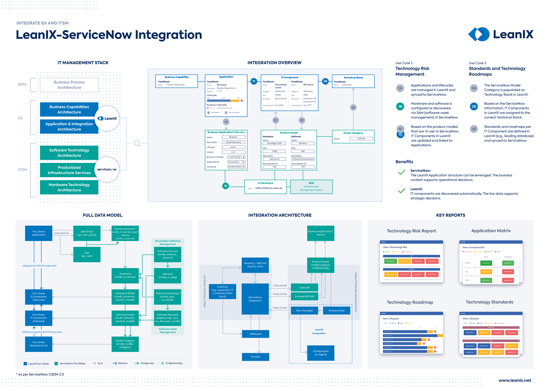
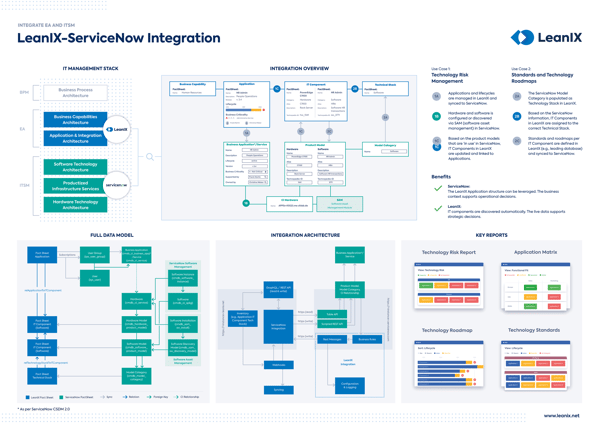
Enterprise architecture creates a record for applications through application portfolio management (APM). By assessing the fitness and business value of each application, the ideal target architecture can be defined. ITSM has its own system and tools that keep records of technologies and help IT teams follow standard ITSM processes. However, if these two systems exist separately, a company loses out on the previously mentioned benefits. The solution lies in integrated toolsets that enable a bi-directional knowledge flow between EA and ITSM teams. This not only creates reusable documentation but also avoids redundant work.
Conclusion
The digital overhaul of all industries has created a need for management approaches that oversee IT services and maximize their value for an organization. This encompasses the strategic planning of the IT infrastructure through application portfolio management (EA) as well as the day-to-day management of operational tasks (ITSM). The latter is controlled by clear ITSM processes that support the overall business strategy.
As EA is the bridge between strategy and technology and ITSM translates this technology into tactical activities, a close collaboration between the two management approaches through integrated toolsets like LeanIX for ServiceNow is recommended.