Partner Program

Maximize market potential through a partner program offering LeanIX solutions tailored to your business model.

Learn more
DTO

Digital Thread

A digital thread is defined as a connected data flow linking design, operation, and change data into a single traceable record supporting governance decisions.

DTO-Gartner-Magic-Quadrant

What is a digital thread?

A digital thread is defined as an integrated data framework that creates a continuous, bidirectional flow of information across all stages of a system’s lifecycle, connecting the data generated at design time, deployment, operation, and change into a single, coherent record. The thread does not store data in a central repository; it provides the connective layer that links data across the systems, tools, and processes involved in each lifecycle stage.

The digital thread concept originated in aerospace and defense engineering, where it describes the connected data record that traces a physical product from design specification through manufacturing, maintenance, and decommissioning. In enterprise architecture, the same principle applies to the IT landscape: the digital thread is the connective data layer that links application design decisions, deployment configurations, operational metadata, and change history into a continuous, traceable record. This is the data foundation that makes the organizational digital twin possible.

Defining properties

The key properties of a digital thread are continuity and traceability. Continuity means that the data record is unbroken across lifecycle stages: a change decision in the architecture model flows into the configuration management database, which flows into the monitoring layer, which feeds back into the model. Traceability means that every state of the system can be traced to the decisions and events that produced it.

Without a digital thread, lifecycle data lives in disconnected systems: architecture decisions in an EA tool, deployment configurations in a CMDB, change history in a ticketing system. Each system has part of the story. The digital thread connects those systems so that the full story is accessible in one place.

How the digital thread works

The digital thread works by establishing connections between the data systems involved in each lifecycle stage and maintaining those connections as data changes. In an enterprise architecture context, this means connecting:

  • Architecture models (application portfolio relationships, business capability maps, target architecture) — the design-time record

  • Configuration management databases (deployed applications, infrastructure components, integration configurations) — the operational record

  • Change and incident systems (project portfolios, change requests, incident history) — the change and event record

  • Performance and monitoring data (application health, API usage, cost data) — the operational signal

The digital thread is the mechanism by which changes in one system propagate to related records in other systems. This keeps the full lifecycle picture current without requiring manual synchronization.

Digital thread vs. digital twin

The digital thread and the digital twin are related but distinct concepts. They are often discussed together because each depends on the other for full value, but they serve different purposes.

Dimension Digital thread Digital twin
What it is A connected data flow across lifecycle stages A model that represents the current state of a system
Primary function Traceability — connecting data across time and systems Simulation and monitoring — representing state at a point in time
Data direction Bidirectional — captures history and propagates changes Current-state snapshot, continuously updated
Scope The full lifecycle — from design through decommissioning The current operational state
Relationship Provides the data that the digital twin uses Consumes the connected data that the thread supplies

The digital thread is the data infrastructure that makes a digital twin possible. A digital twin requires current, accurate data about the system it represents; the digital thread is how that data stays connected and current. A digital twin without a digital thread is a snapshot: accurate at the moment it was created, degrading in accuracy as the underlying system changes without the model updating.

In enterprise architecture, the organizational digital twin represents the current state of the IT landscape and business capabilities. The digital thread is the mechanism by which application changes, new deployments, decommissioning events, and architecture decisions flow into the twin and keep it current.

How they work together

In practice, the digital thread and the digital twin operate as a system. The thread connects the data sources: CMDB, EA models, change systems, monitoring tools. The twin consumes that connected data to present a current, accurate model of the IT landscape. When a change occurs (an application is migrated, an integration is deprecated, a new capability is deployed), the thread propagates that change through connected systems, and the twin updates to reflect the new state.

For an enterprise architect, this means that architecture decisions made in the EA model flow through the thread to affect configuration records, and operational changes in the infrastructure flow back through the thread to update the architecture model. The result is a self-correcting system in which the model and the operational reality stay synchronized.

Success Kit

Enterprise architecture success kit

Everything you need for quick time-to-value and long-term success through EA.

Enterprise architecture success kit

Benefits of a digital thread

The digital thread delivers value in three areas: governance, decision-making, and transformation management.

For enterprise architects

  • Complete lifecycle traceability: Every application, integration, and capability in the portfolio has a connected data record that links its design decisions to its current operational configuration; when a question arises about why an integration was built, what changed it, or what depends on it, the answer is in the thread.
  • Reduced model maintenance burden: Changes in connected systems propagate through the thread to update the EA model automatically, rather than requiring manual model updates after each change; the architecture model stays current as a consequence of the thread, not as a separate maintenance task.
  • Consistent architecture governance: Governance rules applied to the EA model, including technology lifecycle policies, integration standards, ownership requirements, can be validated against current operational data via the thread, rather than against data that may be weeks or months out of date.

For the business

  • Faster transformation decisions: Business and IT leaders can see the full impact of a proposed change, including which applications, capabilities, and processes are affected, without waiting for the EA team to manually trace dependencies; the thread provides that traceability on demand.

  • Audit and compliance readiness: Regulated organizations require traceable records of system changes, ownership, and configuration history; the digital thread maintains that record continuously, reducing the effort required to demonstrate compliance during audits under frameworks like DORA.

  • Reduced rework in programs: Transformation programs that can trace the full lifecycle of affected systems encounter fewer surprises; the thread surfaces the dependencies and history that program plans must account for.

These benefits apply broadly, but the concept itself has a specific origin and domain history that informs how enterprise teams should think about implementing it.


Engineering and enterprise contexts

The digital thread originated in manufacturing and aerospace engineering, where it describes the connected data record that traces a physical product through design, manufacturing, maintenance, and decommissioning. In that context, the thread connects CAD design files, manufacturing process parameters, quality inspection records, maintenance logs, and end-of-life disposal data into a single, traceable product history.

In enterprise architecture, the same principle applies to the lifecycle of IT systems and business capabilities rather than physical products. The digital thread connects the data generated at each stage of an application’s lifecycle, from architecture design and procurement through deployment, operation, change, and decommissioning, into a connected record that supports governance, decision-making, and transformation management.

The distinction between engineering and enterprise contexts matters for implementation: engineering digital threads are built on product lifecycle management (PLM) platforms and CAD data systems. Enterprise digital threads are built on EA management platforms, CMDBs, and IT service management tools. The principle is the same; the data infrastructure is different.

Understanding the tools involved in each layer of the enterprise digital thread clarifies both the implementation scope and the integration decisions that determine how complete the thread becomes.

Software and tools

The digital thread in an enterprise architecture context spans several categories of tooling:

  • Enterprise architecture (EA) platforms provide the architecture model and the governance layer; they are the primary consumer of thread data and the primary source of architecture design decisions

  • Configuration management databases (CMDBs) provide the operational record of deployed systems, configurations, and relationships; they are a primary thread data source

  • IT service management (ITSM) platforms provide the change history and incident record; changes that affect the architecture flow from ITSM into the thread

  • Cloud infrastructure platforms provide API-accessible configuration and deployment data that feeds the operational layer of the thread

  • Integration platforms track the integration layer; when integrations change, those changes must propagate through the thread to the EA model

No single tool provides the complete digital thread. The thread is the integration between these systems: the data flows and synchronization mechanisms that connect the records across platforms.

EA tools, such as SAP LeanIX operationalizes the EA layer of the thread by maintaining a structured application portfolio management model updated through automated data ingestion from connected CMDBs, cloud platforms, and ITSM systems, and by connecting business capability maps to the applications that support them, creating a traceable thread from business strategy through technology deployment. When a capability changes or an application is migrated, the impact propagates through the connected model automatically.


Implementation challenges

  • Integration complexity: Connecting the EA model to CMDBs, ITSM platforms, and cloud APIs requires integration work that varies with the number and type of source systems; organizations with fragmented tooling landscapes face higher initial integration investment.

  • Data consistency across systems: The same application or component may be identified differently in the EA model, the CMDB, and the ITSM platform; establishing consistent identifiers across systems is a prerequisite for reliable thread propagation.

  • Maintaining bidirectional flow: The thread is most valuable when data flows in both directions — changes in the EA model propagate to operational systems, and changes in operational systems propagate to the model; one-directional integrations that only push data from operations to the model miss half the thread’s value.

  • Governance of the thread itself: As systems change and integrations evolve, the thread connections must be maintained; without a clear owner and governance process for the integration layer, the thread degrades over time as connections break and data sources change.

Analyst Report

Digital Twin of an Organization

Download your complimentary copy of the report
and see how SAP solutions were evaluated in this category

Get your complimentary report

MQ2025-Resource Thumbnail-858x600 (1)

FAQs

What is the simplest way to explain the difference between a digital thread and a digital twin?

The digital thread is the connection: the flow of data linking lifecycle stages and systems. The digital twin is the model: the current-state representation of a system built from that connected data. The thread feeds the twin; the twin displays what the thread has connected. You can have a digital twin without a complete digital thread, but the twin will degrade in accuracy as its data sources fall out of sync.

No. The digital thread delivers value incrementally as more systems are connected. Connecting the EA model to a single authoritative CMDB is more valuable than no connection at all, even if ITSM and cloud data sources are not yet integrated. Most organizations implement the digital thread incrementally, starting with their most critical data sources and expanding coverage over time.

The concept originated in manufacturing and aerospace, but the principle applies wherever systems go through a lifecycle (design, deployment, operation, and change) and where traceability of that lifecycle has governance or decision-making value. Enterprise architecture in any industry meets that description. Financial services, healthcare, retail, and public sector organizations all benefit from the digital thread in the EA context.
Decommissioning is part of the lifecycle that the digital thread is designed to capture. When a system is decommissioned, that event should be recorded in the thread: updating the EA model to reflect the decommissioned state, propagating the change to dependent records in other systems, and preserving the history of the system’s operation. The thread maintains the decommissioned system’s record as historical context, which is useful for audit purposes and for tracing the evolution of the IT landscape.

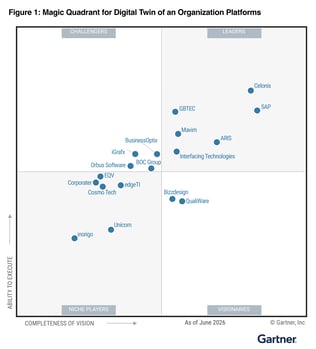
Gartner, Inc. Magic Quadrant for Digital Twin of an Organization Platforms. Marc Kerremans, David Sugden, etl. 27 July 2026.
Gartner and Magic Quadrant are trademarks of Gartner, Inc. and/or its affiliates. Gartner does not endorse any company, vendor, product or service depicted in its publications, and does not advise technology users to select only those vendors with the highest ratings or other designation. Gartner publications consist of the opinions of Gartner’s business and technology insights organization and should not be construed as statements of fact. Gartner disclaims all warranties, expressed or implied, with respect to this publication, including any warranties of merchantability or fitness for a particular purpose.