Elevate your Enterprise Architecture with Artificial Intelligence
Learn moreSAP LeanIX Customers
A growing list of industry leaders and organizations of all sizes who trust in SAP LeanIX
See Full ListMaximize market potential through a partner program offering LeanIX solutions tailored to your business model.
Learn moreTake your capabilities to the next level and arm yourself with the knowledge you need
See all resourcesThe main types of digital twins are component, asset, process, system, and organizational twins, ordered by scope from a single physical part to the full enterprise.
Digital twin types are defined by the scope of what they represent: from a single physical component to an entire organization's IT landscape and business capabilities. The five main types follow a hierarchy of scale: each level contains or connects to the levels below it.
| Type | Scope | Primary use case |
| Component twin | A single part or component within an asset | Engineering validation, failure prediction for individual parts |
| Asset twin | A complete physical asset (a machine, a building, a vehicle) | Operational monitoring, predictive maintenance |
| Process twin | A business or operational process | Process performance monitoring, simulation, conformance checking |
| System twin | Multiple connected assets or processes working together | System-level optimization, interdependency analysis |
| Organizational twin (DTO) | An entire organization — its capabilities, processes, applications, and data | Enterprise transformation, architecture governance, strategic planning |
A component twin is defined as a digital model of a single physical part (a sensor, a pump, a circuit board) that mirrors the component's real-time operational state. Component twins originate in manufacturing and engineering, where they enable engineers to monitor component performance, predict failure, and test design modifications without physical prototyping.
In an enterprise architecture context, the component twin concept maps loosely to the individual application or microservice level: a model of a single technical component within a larger system.
An asset twin is defined as a digital model of a complete physical asset (a production line, a facility, or a piece of infrastructure) that integrates data from all its constituent components into a single operational picture. Asset twins support predictive maintenance, performance optimization, and lifecycle management for physical assets.
In enterprise contexts, the asset twin concept maps to the level of a single enterprise application or platform: a model that integrates data from the application's components, configurations, and connections.
A process twin is defined as a digital model of a business process (the sequence of activities, decisions, and handoffs by which work gets done) built from event log data extracted from the systems executing that process. Process twins enable conformance monitoring, root cause analysis, simulation, and continuous performance management.
The process twin is the type most relevant to process excellence and BPM functions; for the process-framing of this type, see Digital Twins Examples on SAP Signavio.
A system twin is defined as a digital model of multiple connected assets or processes that operate as a system, covering interdependencies, data flows, and performance interactions above the level of any individual asset or process. System twins are used for system-level optimization, interdependency analysis, and scenario planning across interconnected operations.
In enterprise architecture, system twins correspond to the integration and application ecosystem level: they capture how applications connect, how data flows between systems, and how changes in one system propagate across the landscape.
An organizational twin, also called a digital twin of an organization (DTO), is defined as a digital model of an entire organization's IT landscape, business capabilities, processes, and data flows. Leaders use it to simulate transformation scenarios and make architecture decisions before live systems are changed. The DTO is the most enterprise-relevant type of digital twin: it operates at the scale of the full organization, not a single component or asset.
For enterprise architects, the DTO is the type that directly enables impact analysis, architecture governance, and transformation risk management. For CIOs, it is the type that provides the continuous IT landscape visibility needed to make investment decisions on current information.

Success Kit
Everything you need for quick time-to-value and long-term success through EA.
Digital twins and simulations are both used to model and test scenarios, but they differ in a fundamental way: the data they run on.
A simulation is a model that operates on assumed or estimated inputs: parameters that represent what the system might do under defined conditions. A simulation does not require a live connection to the system it models; it runs on the parameters its designers specified.
A digital twin is a model that operates on real data from the system it represents, continuously updated as the system changes. The twin does not simulate assumed behavior; it reflects actual behavior, updated in real time, with simulation capability applied on top of real operational data.
| Dimension | Simulation | Digital twin |
| Data source | Assumed or estimated parameters | Live operational data from the real system |
| Currency | Static — reflects the state at model creation | Dynamic — continuously updated as the system changes |
| Purpose | Test hypothetical scenarios under specified conditions | Monitor real performance and test changes on real data |
| Accuracy dependency | Accuracy of input assumptions | Accuracy and completeness of live data connections |
| Use in decisions | Useful for general-purpose scenario planning | Useful for decisions about a specific, known system |
In practice, digital twins use simulation as one of their capabilities: "what if" scenarios run on real operational data to project the impact of proposed changes. The distinction is not that twins and simulations are mutually exclusive, but that the digital twin's simulation operates on evidence rather than assumptions.
Another distinction that frequently comes up in vendor conversations, though less relevant operationally, is the difference between "digital twin" and "virtual twin."
The term "virtual twin" is used by some vendors, most prominently Dassault Systèmes, to describe a digital twin with a specific emphasis on virtual reality and 3D visualization capabilities. A virtual twin typically includes the same data-connectivity and modeling features as a digital twin, with the addition of immersive visualization interfaces that allow users to explore the model in a 3D or VR environment.
The practical distinction is vendor-specific rather than fundamental: "digital twin" is the broadly accepted term across industry and standards bodies including the Digital Twin Consortium, ISO, and IEC. "Virtual twin" is a brand-differentiated variant used in specific product contexts, most prominently in manufacturing and product lifecycle management.
For enterprise architecture purposes, the digital twin terminology is standard. The organizational digital twin, as defined by Gartner, does not require virtual reality or 3D visualization; it is a data model of the IT landscape and business capabilities that is continuously updated and supports governance and transformation decisions.
The right type of digital twin depends on what you are trying to model and what decisions you need to support. This framework maps organizational use cases to twin types.
| If your goal is... | The relevant twin type is... |
| Monitor and optimize a single enterprise application | Asset twin — model the application's performance, configurations, and dependencies |
| Understand how a business process actually runs | Process twin — mine event log data to construct a live process model |
| Manage the full IT landscape and business capabilities | Organizational twin (DTO) — model the enterprise at the scale of application portfolio management, integrations, and capabilities |
| Analyze dependencies between applications in a program | System twin — model the interconnected application ecosystem |
| Plan a transformation before changing live systems | Organizational twin (DTO) — simulate the proposed target architecture against the current landscape |
The organizational twin is distinct from the other types in three ways: scale, purpose, and the nature of what it models.
Scale: while component, asset, process, and system twins model individual physical or operational objects, the organizational twin models the enterprise as a whole, covering its applications, capabilities, data flows, and organizational structures. This scale makes the DTO the decision-support instrument for strategic and architectural decisions, not just operational monitoring.
Purpose: the primary purpose of lower-level twin types is operational performance monitoring and optimization: detecting failures, improving throughput, reducing waste in a specific system or process. The primary purpose of the organizational twin is governance and transformation management. This means architecture decisions grounded in accurate information, transformation programs that account for real dependencies, and continuous IT landscape visibility for the people responsible for managing it.
What it models: component and asset twins model physical objects that exist in the world independent of the organization's decisions. The organizational twin models a constructed reality: the IT landscape, business capabilities, and organizational structures that the organization has built and continues to change. The accuracy of the organizational twin depends not just on data connectivity, but on the quality of the architecture model that structures that data.
SAP LeanIX provides the application portfolio management model, business capability maps, and architecture governance capabilities that constitute the DTO for enterprise architects. Building and maintaining the organizational twin does not require a separate modeling effort on top of existing EA tooling.
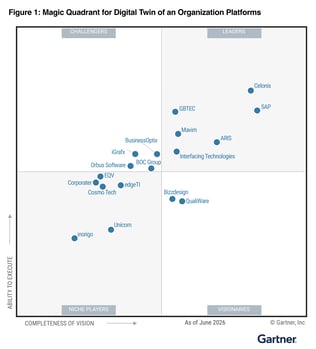
Download your complimentary copy of the report
and see how SAP solutions were evaluated in this category
Do I need to implement all types of digital twins, or can I start with just the organizational twin?
You can start with any type independently. Most enterprise architecture functions begin with the organizational twin because it operates at the level of their responsibilities: the IT landscape and business capabilities. Lower-level twin types (process, asset, component) are typically owned by different functions: process excellence teams own process twins, operations teams own asset twins. The organizational twin can be implemented without any of the lower types in place, though connecting process and system data into the DTO increases its accuracy.
What is the difference between an organizational twin and a CMDB?
A configuration management database (CMDB) maintains a structured record of IT assets, their configurations, and their relationships. An organizational twin uses the CMDB as one of its data sources, but extends it with business capability mapping, architecture modeling, impact analysis, and scenario planning capabilities. The CMDB records what exists; the organizational twin models what it means for business and technology decisions.
Is the process twin the same as what SAP Signavio provides?
The process twin type describes any data-driven process model built from execution data and used for performance monitoring and simulation. SAP Signavio Process Intelligence provides the platform for building and operating process twins. It uses process mining to construct the data foundation, BPMN to provide the structural reference, and simulation for scenario testing. The process twin is a type; SAP Signavio is the platform that enables it.
Can the same system function as multiple types of digital twin simultaneously?
Yes. A digital twin of a manufacturing plant might function simultaneously as an asset twin (monitoring the plant's equipment), a system twin (modeling how production lines interact), and as an input to the organizational twin (representing the plant's contribution to the enterprise IT landscape and business capabilities). The type classification describes the scope of what is being modeled, not a limitation on what any single platform can represent.
Gartner, Inc. Magic Quadrant for Digital Twin of an Organization Platforms. Marc Kerremans, David Sugden, etl. 27 July 2026.
Gartner and Magic Quadrant are trademarks of Gartner, Inc. and/or its affiliates. Gartner does not endorse any company, vendor, product or service depicted in its publications, and does not advise technology users to select only those vendors with the highest ratings or other designation. Gartner publications consist of the opinions of Gartner’s business and technology insights organization and should not be construed as statements of fact. Gartner disclaims all warranties, expressed or implied, with respect to this publication, including any warranties of merchantability or fitness for a particular purpose.
Free Analyst Report
2026 Gartner Magic Quadrant for Digital Twin or an Organization Platforms
Download Report