Partner Program

Maximize market potential through a partner program offering LeanIX solutions tailored to your business model.

Learn more
EA Deliverables

Enterprise Architecture Repository

An enterprise architecture repository is a central, structured system of record for an organization's applications, business capabilities, technologies, and the relationships between them.

► Learn four steps that will generate ongoing business value, fast.

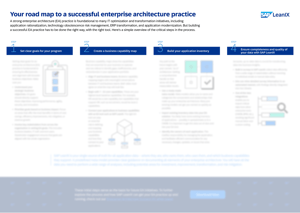
EN-LP-1P-road-map-to-successful-ea-780x555
Enterprise Architecture Fundamentals Enterprise Architecture Repository

Enterprise architecture depends on a shared, current picture of the landscape, and that picture has to reside somewhere. The repository is where it resides, holding every application, capability, and dependency and consolidating them into a single model the organization can actually query.

It is what keeps EA deliverables and documentation consistent with one another, rather than drifting into separate and conflicting versions of the truth.

What is an enterprise architecture repository?

An enterprise architecture repository is the central system of record for everything an EA practice needs to reason about the landscape: applications, the technologies beneath them, the business capabilities they support, and the relationships that connect those elements. It is the single source of truth that lets teams answer questions about the landscape from one place, instead of reconstructing the picture each time from spreadsheets and individual memory.

A repository is more than storage: a document store holds files, whereas a repository holds a connected model, where each record (an application, a capability, a technology component) is typed, described by attributes, and linked to the records it depends on. That structure is the difference between an archive you read and a model you can query. It is also what lets a repository answer the questions that matter to senior stakeholders, which is the clearest way to understand what one is for.


How organizations use an EA repository?

Repositories prove their value through the decisions they support, not the data they store. The same connected model answers questions across rationalization, risk, transformation, and governance, and increasingly feeds the AI systems now operating inside the landscape. Four established uses show what a repository enables today, and a fifth shows where it is heading.

1. Application rationalization

A current, complete view of the portfolio is the precondition for defensible rationalization. Teams that decommission applications without reliable dependency data discover mid-project that they removed something still in use, or retained something with hidden ties. The repository supplies the coverage and relationship data that makes application rationalization decisions hold up under scrutiny.

2. Technology risk management

Aging infrastructure, unsupported software, and compliance gaps only become visible when the inventory is both complete and current. Technology risk management draws straight from repository data: gaps in lifecycle or ownership fields produce unreliable risk signals, so coverage quality sets the ceiling on how far teams can trust the risk view.

3. Transformation planning

Cloud migrations, ERP (SAP) programs, and consolidation efforts all require an accurate current state before anyone can plan the target state. A repository that reflects today's landscape rather than last year's is what separates a transformation plan from a guess.

4. Stakeholder communication

CIOs, business leaders, and program managers each require a different representation of the same underlying data. A maintained repository enables the EA team to generate dashboards, heat maps, and roadmap views for each audience without reconstructing the underlying data every time.

Where EA repositories are heading?

The scope of the repository is widening. Alongside traditional applications, a modern repository now tracks SaaS, self-built software, and the AI agents being deployed across the business. As AI agents become operational components of business processes, they need the same documentation, ownership, and governance as any other system, and the repository is where that record belongs.

Two shifts follow from this.

The repository is moving from a periodically refreshed snapshot toward a continuously updated, real-time system, maintained through automated discovery and AI-assisted enrichment rather than manual data entry, and it is simultaneously becoming a source that AI itself consumes: the structured, trusted context an AI system needs to reason about the landscape safely.

The purpose of AI-native enterprise architecture is shifting from documenting the past toward providing the live, trusted foundation that both people and AI act on, and the repository is the asset that shift depends on.

Guide

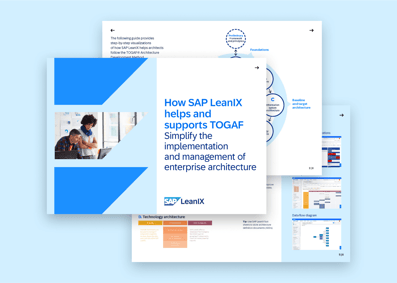
An agile framework to implement TOGAF with LeanIX' enterprise architecture tool

A step-by-step illustration of how to follow TOGAF’s principles with a lean EA tool.

An agile framework to implement TOGAF with LeanIX' enterprise architecture tool

What an EA repository contains?

An enterprise architecture repository is organized around defined object types, their attributes, and the relationships between them. The value comes from the relationships between records, not the records themselves: a simple inventory records what exists, while a connected model reveals what would break if you changed it. Most repositories are built from the same core layers.

  • Application and technology inventory. Every application in scope and the technology components beneath it (databases, middleware, infrastructure), each described by attributes such as business owner, lifecycle status, hosting model, and business criticality. A modern repository extends this beyond classic applications to SaaS, self-built software, and AI agents, so the inventory reflects the landscape as it actually runs. This application inventory is the base layer every other EA output depends on.

  • Business capability model. A structured view of what the organization does, independent of how it does it. Business capabilities link the business layer to the technology layer, so teams can see which systems support which capabilities and where gaps, duplication, or transformation pressure sit.

  • Relationships and dependencies. The connections between records: applications to capabilities, interfaces between systems, data flows, and ownership. These relationships are what make a repository analytical rather than descriptive, turning a catalog into an impact-analysis tool.

  • Lifecycle and roadmap data. Target dates, planned replacements, consolidation decisions, and the current-versus-future state of each system. This converts a static inventory into a forward-looking planning instrument.

  • Architecture decisions and standards. Approved technology standards, reference architectures, exception records, and the formal decisions that constrain future choices. This captures the governing logic of the practice as data, rather than leaving it scattered across documents.

How these records are typed and connected is defined by the EA meta model, not by any single framework. A consistent meta model is what makes the repository queryable, rather than a disconnected archive of documents.

The idea of a structured architecture repository was formalized by TOGAF, and established EA frameworks can inform the model, but a practical meta model is configurable: teams adapt it to their own scope, governance, and reporting needs rather than copy a standard as written.

Repository maturity

The completeness and trustworthiness of these layers varies widely, and that variation has a name: repository maturity. SAP LeanIX frames EA maturity in five stages, and a repository matures along the same path.

Stage What the repository looks like
Explorer Data scattered across silos and spreadsheets; no dedicated EA tool; no operational use cases executed yet
Rising Star Key data sources identified; tooling introduced; foundational use cases supported for early adopters
Pro Data structured and operationally useful; core integrations in place; adoption spreading across the organization
Leader Data quality trusted for analytics-based decisions; EA tooling integrated across IT; continuous transformation driven from the model
Legend Data acts as the real-time foundation for strategic initiatives; the repository is central to how IT transformation runs

Most organizations running an EA tool sit at Rising Star or Pro and progress toward Leader. The move up is rarely about features; it depends on ownership, review cadence, and data-quality standards, which is why maturity tracks organizational discipline more than tool capability.

Reaching the higher stages is largely a question of how the repository is built and maintained.

How to build an EA repository?

Building a repository is more an organizational effort than a technical one. The common failure is rarely the tooling; it is treating the repository as a one-time inventory that no one owns once the project ends.

Three steps keep it accurate and useful as the landscape grows.

1. Start with coverage, not completeness

The most frequent mistake is chasing total coverage before producing any output. A repository covering the business-critical portfolio with accurate ownership and lifecycle data delivers governance value long before it is complete. A workable first baseline includes:

  • Application inventory scoped to business-critical and regulated systems

  • Business capability map at level 1–2

  • Lifecycle and ownership data for all in-scope applications

  • Initial target architecture for one priority transformation area

Expanding scope and enriching attributes pays off from there, but only once that baseline exists and is in use.

2. Define data ownership before you start populating

Repository data decays unless someone is accountable for keeping it current, and the EA team cannot maintain thousands of records alone. Ownership has to sit with the people who actually know each system.

Application owners maintain the operational layer: lifecycle status, business function, interfaces, and technical contacts.

The EA team owns the governance layer: relationships between entities, completeness standards, and the views senior stakeholders consume. Sustaining that split over time is a question of EA data quality, not a one-off import.

3. Choose a repository tool that scales

Where the repository lives determines whether it survives contact with a growing landscape, and the four common options are not equal.

  • Spreadsheets are where many teams start, and for a small organization with few applications they can be enough. The limits appear as the landscape grows: maintenance stays manual, the error rate rises, and a spreadsheet cannot model relationships, run impact analysis, or refresh itself through discovery.

  • Open-source EA tools remove licensing cost and offer a real meta model, but they move the burden onto the team. Hosting, integrations, upgrades, and discovery usually have to be built and maintained in-house, which is only sustainable where there is dedicated engineering capacity to carry it.

  • Custom or "vibe-coded" tools, meaning an internal app assembled quickly and increasingly with AI coding assistants, can model exactly what a team wants on day one. The risk is longevity: discovery, integrations, access control, and data quality are hard to sustain as the landscape and the team change, and the tool often decays into another silo.

  • Purpose-built EA tools exist to solve these problems at portfolio scale. The decision that matters is not which option has the most features, but whether the repository stays complete and current without unsustainable manual effort, and whether it can drive the work EA exists for: guiding data-supported transformations, cutting cost, and improving the technology landscape over time.

    A dedicated EA tool provides automated discovery, a configurable meta model, relationship modeling, and the governance and access controls that keep data trustworthy as it grows, including coverage of the SaaS, self-built software, and AI agents that spreadsheets and ad-hoc tools miss.

SAP LeanIX EA is one such tool. It imports application data from Excel, ServiceNow, and SAP systems to seed the repository, then uses automated discovery to surface applications, SaaS, and AI agents that never made it onto a manually maintained list.

One enterprise architect describes the result as "clear, real-time visibility into the IT landscape, helping align business and IT for smarter decision-making" (G2, 4.5★).

EN-LP-1P-road-map-to-successful-ea-780x555

Free Poster

6 Steps for Achieving Quick and Sustainable Value with EA.

Download
Free Poster

Enterprise Architecture Roadmap

Learn 6 steps of Enterprise Architecture that will generate ongoing business value, fast.

Get your free Copy

EN-LP-1P-road-map-to-successful-ea-780x555
check icon

Establish an enterprise architecture practice

check icon

Maintain an enterprise architecture practice

check icon

Generate ongoing business value of EA, fast

FAQs

Is an EA repository the same thing as application portfolio management?

No. The repository is the underlying body of data; application portfolio management is one discipline that uses it. A repository also supports risk management, transformation planning, and governance. Treating the repository as only an APM inventory is what causes it to stall as a one-time exercise rather than a living model that several practices draw on.
The tool is the software; the repository is the structured data it manages. A tool with a poorly maintained repository has no analytical value, and a repository without a structured tool becomes unmanageable at scale. In practice the two are inseparable: the repository gives the tool a purpose, and the tool keeps the repository governable.
Usually yes. A CMDB records technical configuration items for IT operations; an EA repository connects applications to business capabilities, lifecycle plans, and transformation decisions. The two overlap on inventory but answer different questions. Many teams feed CMDB data into the repository as one source, then enrich it with the business and roadmap context a CMDB does not hold.
Distribute ownership and review on a cadence. When application owners maintain the fields only they can verify, and the EA team governs relationships and standards, the data stays current without one team carrying all of it. Automated discovery helps by flagging new or changed systems, but accountability is what keeps the model honest. Repositories degrade fastest when access is restricted to the EA team alone.
Access should mirror the ownership model. Application owners get write access to the records they are responsible for; business stakeholders and leaders get read access to dashboards and reports; the EA team governs access and the shared layer. Locking editing to the EA team undermines distributed ownership and speeds up data decay.