
/Guide_BC_WhitePaper_Resource_Page_Thumbnail.png?width=260&height=171&name=Guide_BC_WhitePaper_Resource_Page_Thumbnail.png)
/Manufacturing-BC_Guide-WP-Resource_Page_Thumbnail.png?width=260&height=171&name=Manufacturing-BC_Guide-WP-Resource_Page_Thumbnail.png)
Best Practices to Define Business Capability Maps
See how IT and business align with a complete overview of your business capability landscape.
Elevate your Enterprise Architecture with Artificial Intelligence
Learn moreSAP LeanIX Customers
A growing list of industry leaders and organizations of all sizes who trust in SAP LeanIX
See Full ListMaximize market potential through a partner program offering LeanIX solutions tailored to your business model.
Learn moreTake your capabilities to the next level and arm yourself with the knowledge you need
See all resourcesA business capability map shows what an organization must do to achieve its strategy. This guide outlines how to define capabilities for clear business–IT alignment and planning.
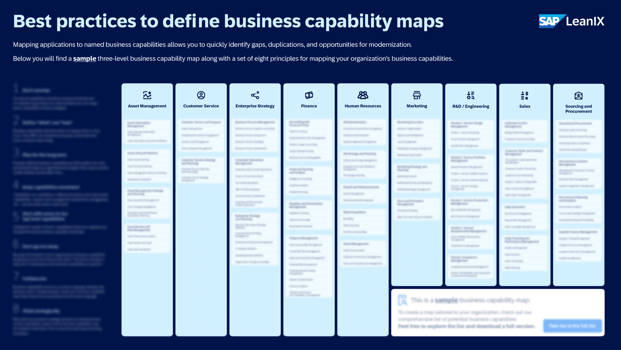
A business capability map provides a unified view of what an organization must be able to do to achieve its strategic objectives. Rather than focusing on how work gets done, it defines the stable foundation of functions that enable strategy execution and technology alignment within the broader business architecture.
When defined and linked to business applications and departments, the map becomes a shared language between leadership, IT, and operations, supporting decisions on investment or de-investment, modernization, and transformation.
This guide explains how to create and maintain that map in practice. It outlines a structured, workshop-based approach for defining capabilities.
Unlike the conceptual overview provided in business capability definition, this page focuses on the operational steps — from preparation to stakeholder setup.
By the end, you’ll understand how to translate strategy into a well-defined capability model that supports all use cases of enterprise architecture, from rationalization, ERP transformation, and continuous improvement.
For reference models, sample structures, and industry examples, see the collection of business capability map examples and templates.
📚 Related: 2025 Gartner® Magic Quadrant™ for Enterprise Architecture Tools
Creating a business capability map is not a documentation exercise — it is a strategic alignment effort that helps translate goals into the structural language of the enterprise.
Before any mapping workshop begins, the organization needs to clarify its intent, define the boundaries of the exercise, and identify the right people and inputs. These early decisions shape whether the resulting map becomes a living management tool or just another diagram on a slide.
A capability map must always serve a business purpose. Review the company’s strategic plan, major transformation programs, or investment initiatives, and determine how the map will help achieve them.
For some, the aim is to guide ERP transformation or post-merger integration; for others, it’s to rationalize applications or improve governance.
By linking the mapping effort directly to strategy, the map becomes a planning instrument that supports informed, traceable decisions instead of a conceptual model detached from operations.
Once the purpose is clear, establish what the map will cover.
Some organizations begin with an enterprise-wide capability map to define a common taxonomy and shared understanding of the business model. Others start with a specific domain — such as Finance, Manufacturing, or Customer Engagement — to support ongoing transformation work.
Either approach can work if it maintains alignment with corporate strategy and uses a consistent hierarchy. When defining the scope, reference existing frameworks or industry structures.
Adapting the terminology and level of detail from the business capability map examples can speed up the process and help maintain comparability with sector peers.
A capability map is only valuable if the right people contribute to and trust it. Bring together stakeholders who represent strategy, execution, and technology. Key participants typically include:
Define ownership and maintenance responsibilities early. Assign a governance model that specifies who approves structural changes and how frequently the map will be reviewed — quarterly for dynamic organizations, annually for more stable ones. This rhythm ensures the capability model remains accurate as strategies evolve.
Preparation significantly improves the quality of mapping sessions. Collect information that provides both top-down and bottom-up perspectives, such as:
These materials help participants ground discussions in factual data instead of assumptions. When everyone enters the room with a shared understanding of current state, workshops can focus on defining future capabilities rather than debating existing ones.
Use collaborative tools that allow capabilities to be captured, linked, and visualized in one place. Enterprise architecture platforms such as SAP LeanIX can model capabilities, connect them to applications and departments, and generate dashboards for leadership visibility.
Diagramming tools are suitable for initial design sessions, while spreadsheets or CMDB data sources can feed information into a centralized repository later.
The key is to establish a single source of truth where capability information is stored, updated, and shared across teams.
Facilitator Instructions
Poster
Optimizing your enterprise architecture begins with a structured overview.
A business capability map only delivers value when it directly reflects what the organization is trying to achieve.
This first step anchors the mapping exercise in strategic intent, ensuring that every capability later defined can be traced back to measurable business outcome.
Begin by reviewing strategic documents such as annual goals, transformation roadmaps, or investment themes.
Identify the strategic outcomes leadership wants to achieve — for example, expanding into new markets, improving supply resilience, or shifting to recurring revenue. Each outcome represents a why that the capability map will later translate into a what.
For instance, if the strategy emphasizes customer-centric growth, the related capabilities could include Customer Relationship Management, Customer Insights & Analytics, and Experience Design. Likewise, a focus on operational excellence might translate into Production Planning, Supply Chain Optimization, or Quality Management.
The key is to capture what the business must be able to do — not how it currently does it.
A helpful technique is to organize these goals under a few strategic pillars (e.g., Growth, Efficiency, Risk, Innovation) and begin listing what each pillar requires from the business.
The result is a bridge between high-level vision statements and the tangible functions that will soon form the first layer of your capability map.
Strategy interpretation cannot be delegated entirely to architecture teams. Senior business stakeholders must validate how their objectives are represented in capability terms. Involving them now reduces resistance later when the map is used to justify investment or change.
Early alignment also encourages consistent terminology: the way leadership talks about “digital customer experience” or “supply resilience” should match the way those capabilities appear in the model.
During this phase, avoid diving into processes, systems, or team structures.
Capabilities describe what must be true for the organization to succeed, regardless of how it is achieved or who delivers it. The best definitions are stable over time — enduring even when technology or organizational design changes.
Linking these outcomes to the broader business architecture framework helps maintain consistency with value streams, strategic objectives, and transformation initiatives that may already exist in your enterprise planning environment.
Facilitator Instructions
Once strategic objectives are clear, the next step is to describe the organization in terms of its core abilities — the foundational functions that express what the business does to achieve those objectives.
These Level-1 (L1) capabilities define the enterprise at its broadest level and serve as the top layer of your capability map.
Each Level-1 capability should represent a stable, outcome-oriented function that remains valid even as organizational structures, technologies, or products evolve. Typical examples include Customer Management, Product Development, Supply Chain Management, Finance, and Workforce Management.
Good capability names describe outcomes or responsibilities, not actions or departments. For instance:
When in doubt, remember that a capability answers what the business must be able to do — not how it is done or who does it.
Most organizations identify seven to ten Level-1 capabilities. Fewer than that can lead to overly broad categories that lack decision-making value, while too many dilute focus and create unnecessary complexity.
Think of Level-1 as the anchor points of the business model — broad enough to cover the full scope, but distinct enough to prevent overlap.
If your organization operates across multiple business units or geographies, align on a single corporate structure for Level-1. Domain-specific nuances (e.g., regional sales, product types, or delivery channels) can be captured later at Level-2 or Level-3.
Industry examples and reference models are useful starting points, but they should never dictate your terminology. Drawing inspiration from the business capability map templates can accelerate the process, yet every organization must adjust language to reflect its own strategy and culture.
For example, two banks may both have a “Customer Management” capability, but one might include wealth-advisory functions while the other separates retail and institutional customer management. The goal is to adopt a naming convention that executives and teams intuitively recognize and can use for decision-making.
After drafting the initial list, validate that the Level-1 capabilities collectively describe the organization’s full value creation cycle — from market analysis and product development to sales, delivery, and support.
This top layer becomes the foundation on which all subsequent detail will rest, so it must be both comprehensive and non-overlapping.
A quick test: if a major function of the company cannot be placed under one of your Level-1 categories, the model is incomplete. If a function could fit under multiple categories, the boundaries need refinement.
Facilitator Instructions
After defining the top layer of the business capability map, the next step is to decompose each Level-1 capability into more detailed, but still outcome-focused, sub-capabilities.
These Level-2 and Level-3 capabilities create the structure that connects strategic intent with operational insight. The right level of granularity allows the organization to analyze performance, assign ownership, and link applications and users without losing clarity.
Think of Level-1 capabilities as the chapters of a book, and Level-2 and Level-3 as the subheadings that organize its content. Each Level-2 capability should describe a distinct outcome or responsibility that contributes to the parent capability.
For example:
Each Level-2 can then be expanded into Level-3, but only where further detail is necessary to support decision-making — such as linking applications, measuring maturity, or assigning ownership.
The goal is traceability without overcomplication: three levels are typically sufficient for enterprise analysis.
As the hierarchy expands, resist the temptation to describe activities, processes, or roles. Capabilities remain outcome-based and agnostic of how or where work is performed.
For example, “Customer Support” is a capability, while “Manage Customer Tickets in CRM” describes a process or activity. Maintaining this distinction ensures that the model remains stable over time, even as technologies or processes change.
Consistency is critical for readability and governance. Use a uniform naming convention (e.g., noun + qualifier: “Data Management,” “Contract Administration”) and ensure that all capabilities are written in the same grammatical form.
Include short, plain-language definitions that describe the outcome of each capability, not its workflow. These definitions reduce ambiguity when teams later connect applications, owners, and KPIs.
Depth should be determined by the map’s intended use.
Adding more detail rarely increases value; it typically blurs accountability and makes maintenance harder.
As a rule of thumb, stop decomposing when additional detail would only describe how something is done, not what must be achieved.
As sub-capabilities emerge, review the hierarchy across domains to identify overlaps or dependencies. For example, “Customer Analytics” may appear under both Marketing and Customer Management; these should be reconciled or explicitly linked to prevent duplication.
This cross-check ensures the map can later serve as a consistent foundation for enterprise-wide planning and reporting.
Facilitator Instructions
Once the capability hierarchy has been drafted, it must be refined to ensure that it is both comprehensive and unambiguous. A capability map that overlaps or leaves gaps quickly loses credibility when used for planning or portfolio decisions.
The MECE principle — Mutually Exclusive and Collectively Exhaustive — provides a simple yet powerful test of structural quality.
Start by reviewing each capability and asking whether any two describe the same outcome in slightly different terms. Overlaps often occur between adjacent business domains, such as “Customer Analytics” in Marketing and “Customer Insights” in Customer Management, or between functional and cross-functional areas like “Talent Acquisition” versus “Recruitment.”
When duplication is identified, decide which capability should own the outcome and either merge or reword the other. Clear boundaries not only improve readability but also prevent future disputes when linking applications, budgets, or KPIs.
Completeness ensures that all major business functions are represented. To test this, trace each strategic objective identified in Step 1 through the hierarchy. If a key goal cannot be supported by any capability, the model has a gap.
For example, if a company’s strategy includes expanding subscription revenue but there is no capability related to Subscription Billing or Recurring Revenue Management, the structure is incomplete.
Gaps like this signal missing functions that must be defined before the map can support transformation or investment decisions.
Even well-structured maps can fail if they reflect only one department’s perspective. Validation workshops should include representatives from multiple domains to test whether capability boundaries make sense enterprise-wide.
Encourage open discussion about ownership and overlaps; the goal is not perfection, but consensus on a shared view of how the business is structured.
In some cases, it helps to test the model with actual examples — assigning a few existing applications or processes to capabilities to see where confusion arises. Misalignments at this stage reveal where capability names or definitions need clarification.
During the review, record any adjustments made — such as merged capabilities, renamed terms, or added gaps — along with a short justification. This documentation creates a clear audit trail for future revisions and helps maintain the integrity of the capability taxonomy as it evolves.
Facilitator Instructions
A business capability map creates value when it informs action. Once capabilities are defined, you can map application inventory and organizations (entities, user groups) to business capabilities. After, the map becomes a practical tool for steering transformation and investment decisions.
Treat the capability map as a living asset. Assign ownership, review it annually, and update it after major strategic or technology changes. Integrated into enterprise architecture governance — for example with SAP LeanIX — it links strategy, applications, and roadmaps, maintaining transparency from business goals to execution.
A well-maintained capability map becomes the organization’s shared language for transformation.
Free poster
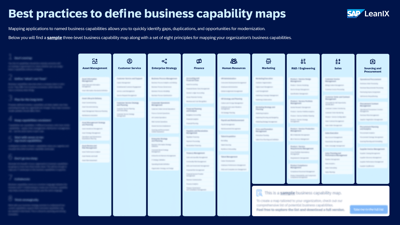
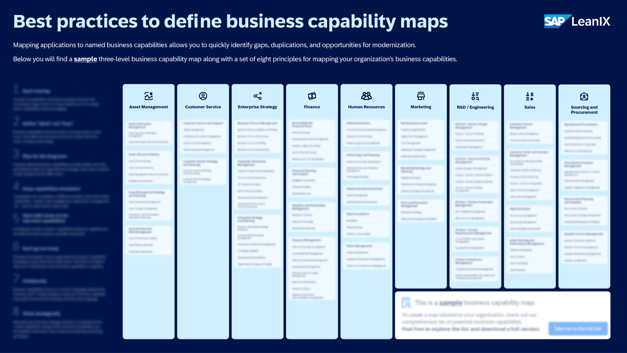
See how IT and business align with a complete overview of your business capability landscape.
What is the ideal number of business capabilities to start with?
Most organizations begin with 7–10 Level-1 capabilities to cover the entire enterprise without losing clarity. Additional sub-capabilities can be added later as the map matures.
How often should a capability map be updated?
Review the map annually or whenever major strategic or technology changes occur — such as a merger, ERP transformation, or new product line. Frequent updates ensure the map continues to reflect reality.
Who should own the business capability map?
Ownership typically sits with the enterprise architecture or business architecture function, in collaboration with business leaders. IT maintains the data, but the business must define and approve capability boundaries.
Can we use an industry reference model instead of building our own?
Reference models are a useful starting point, but they should always be adapted to match your organization’s terminology and strategy. Copying them directly can reduce relevance and stakeholder buy-in.
How does SAP LeanIX support capability mapping?
SAP LeanIX connects capabilities with applications, users, processes, and technologies, enabling automated heat maps, portfolio dashboards, and roadmap integration. It turns the capability map into a live, continuously updated decision-support tool.
See how IT and business align with a complete overview of your business capability landscape.
Define your business capabilities!
